The Conductive Labs NDLR: A Chord-Driven MIDI Brain for Your Synths
There is something genuinely refreshing about a piece of gear that solves a problem most musicians know but rarely talk about: you have three or four synthesizers on your desk, but only two hands and - let's be honest - limited keyboard chops. The Conductive Labs NDLR (pronounced "Noodler") was built precisely for this situation. It sits between you and your synths, generating harmonically coherent MIDI across four independent parts, all locked to the same key and chord. It does not make sound itself. Instead, it makes everything else sound better together.
Chords First, Notes Later
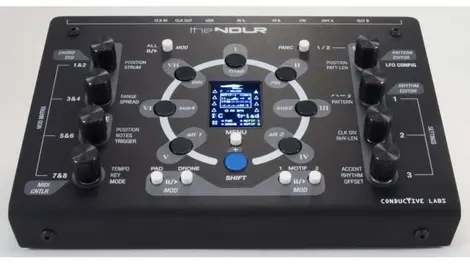
The NDLR's approach to sequencing is fundamentally different from a traditional step sequencer. Rather than programming individual notes on a grid, you work at a higher level of abstraction - choosing keys, scales, chord degrees, and chord types. Seven dedicated buttons on the front panel correspond to scale degrees I through VII. Press one and all four parts immediately respond, playing notes that belong to that chord within the selected scale.
This means you do not need to know which notes make up a D minor seventh chord. You select a key, pick a mode, press a button, and the NDLR handles the theory. Everything stays in key automatically. It is a bit like having a very patient music theory teacher built into a metal box.
Four Parts, One Harmonic Centre
The NDLR divides its output into four distinct musical parts, each with its own MIDI channel and character:
Pad is a polyphonic chord player designed for lush sustained sounds. It can stack up to 49 notes of polyphony across 22 chord levels, with adjustable strum patterns, speed, note range, and spread. Moving the position and range parameters turns notes on and off, which makes it excellent for slowly evolving soundscapes.
Drone plays continuous held notes - a root, optionally with a third and fifth added. Multiple retrigger options (on chord change, on the downbeat, every beat, or continuous) make it versatile enough for bass lines, sustained pads, or even rhythmic kick patterns.
Motif 1 and Motif 2 are two independent sequenced arpeggiators where - and this is the clever bit - note patterns and rhythm patterns are entered separately. A note pattern can be up to 16 steps; a rhythm pattern can be up to 32 steps. Since the two sequences run independently at different lengths, they create constantly shifting combinations. Each motif has its own clock division, direction, octave range, and pattern type (scale, chord, or chromatic).
The Chord Sequencer
For hands-free performance, the NDLR includes a chord sequencer that automates chord progressions. You can program three sections (A, B, and C) with up to six steps each, where every step defines a duration, key, mode, chord degree, and chord type. String the sections together and the NDLR will walk through your progression whilst all four parts follow along, generating their respective patterns against each chord change.
It is remarkably effective for live performance. Set up a progression, press play on all four parts, and four synthesizers start playing together in perfect harmonic agreement. From there, you can tweak parameters, swap patterns, or modulate settings in real time.
Modulation and Movement
A built-in modulation matrix with eight routing slots keeps things from sounding static. Three LFOs - with rates from 0.4 to 40 seconds, or beat-synced from 1 to 48 beats - can be routed to nearly any parameter. Wave shapes include sine, triangle, square, pulse, sample-and-hold, and pattern-based options. Pitch bend, velocity, MIDI CCs, and aftertouch can also serve as modulation sources.
The Rev2 firmware (V3, released in August 2025) added Euclidean rhythm mode with adjustable length, beats, and rotation, plus a Perlin noise pattern generator for organic, slowly evolving sequences that never quite repeat. These additions push the NDLR firmly into generative territory.
Built to Last
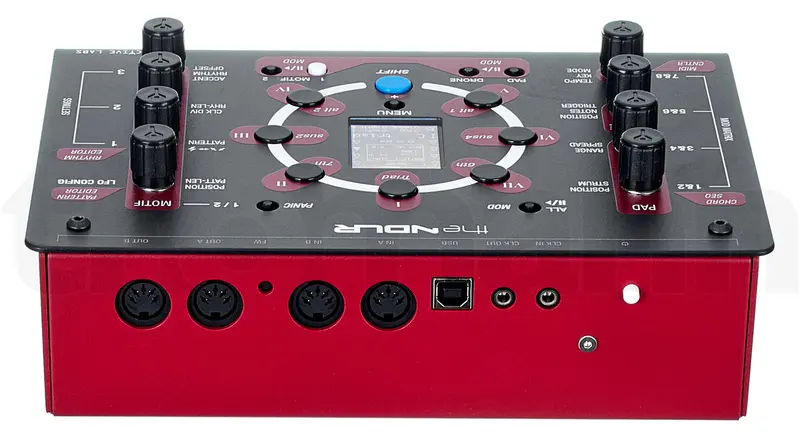
The hardware itself is compact - roughly 23 by 16 centimetres - housed in a powder-coated aluminium enclosure that feels solid without being heavy. Eight rotary encoders with push switches handle parameter editing on a small colour LCD. Connectivity is generous: two 5-pin DIN MIDI inputs, two outputs, USB (providing four virtual MIDI ports plus power), and 3.5mm clock in/out jacks for syncing with modular gear.
The NDLR originally launched through Kickstarter in 2017, designed by Darryl McGee and Steve Barile in Portland, Oregon. The Rev1 was built around a Teensy 3.2 microcontroller, which led to availability problems during the chip shortage years. The Rev2, debuted at Knobcon 2023, upgraded to a Teensy 4.0 with a faster processor and more storage - along with a red powder-coated base that distinguishes it from the original blue-grey model.
Who Is It For?
The NDLR is not trying to replace your DAW or your favourite step sequencer. It occupies a different space entirely - one where you think in chords and musical structures rather than individual note events. If you have a desk full of synthesizers and want them all playing together harmonically without reaching for a laptop, the NDLR does exactly that.
It also has a genuine charm for people who approach music from a sound design perspective rather than a compositional one. You can set up the four parts, start the chord sequencer, route some LFOs to key parameters, and simply listen as the NDLR generates music that evolves on its own. With over six million possible motif combinations according to Conductive Labs, there is always something new to discover.
The concept has clearly resonated - Conductive Labs notes that their chord-driven multi-part approach has been widely imitated since the NDLR first appeared. But the original remains a thoughtfully designed instrument that rewards exploration, whether you are an experienced keyboardist looking for inspiration or someone who simply wants their synths to play nice together.
More News
Notes