Destiny Plus Programma 900 2.0: A Harmonic Musical Computer
Some instruments arrive on the scene making bold claims about breaking new ground, only to deliver incremental improvements on familiar themes. The Programma 900 2.0 from UK-based Destiny Plus - the same minds behind the Czochralski cells drum synth and Entanglement Space multi-FX - is not one of those instruments. This self-described "harmonic musical computer" genuinely charts its own course through additive synthesis territory.
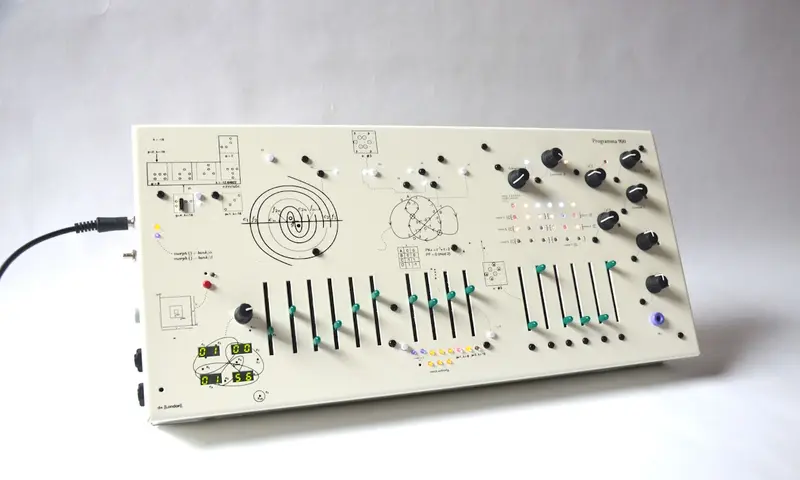
Six Polytonal Voices
At its heart, the Programma 900 2.0 is built on FPGA and ARM Cortex technology, giving it the processing power needed for its complex voice architecture. Each of the six polytonal voices offers independent control over odd harmonics, even harmonics, harmonic partials, harmonic tilt, and fundamental frequency. The four-quadrant multiplication feature allows individual voices to interact in sophisticated ways, creating timbres that shift and evolve far beyond standard additive synthesis.
The spectral morphing and harmonic lock capabilities in version 2.0 add another dimension to sound design. Rather than simply mixing between preset states, these features allow for fluid transitions between harmonic configurations while maintaining musical coherence.
Modulation Without Limits
Where the Programma 900 2.0 truly distinguishes itself is in its modulation architecture. The instrument features 32 gestural CV buffers, each capable of recording up to 6 minutes of parameter changes. These recordings can be applied to any of the 3,000 modulation destinations available, with individual speed and attenuation modes per buffer. This essentially turns the synthesizer into a device that can remember and replay complex performance gestures across an enormous parameter space.
The MIDI implementation is equally comprehensive, featuring a 3,000-note record buffer with looping capabilities and a MIDI matrix that enables per-note function assignment. Three-location A-B-C pan controls provide spatial positioning for each voice, whilst six interpolating morphing inputs add yet another layer of real-time control possibilities.
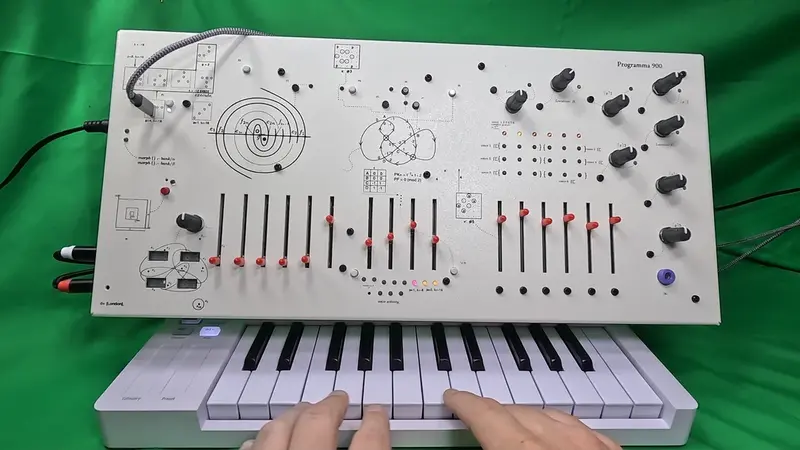
Nine Experimental DSP Algorithms
Version 2.0 introduces nine DSP algorithms that lean heavily into experimental sound processing. The evocatively named effects include Dorcrinx Time - a regenerative delay offering up to 6 minutes of delay time with various "time-complication" modes - and Silver Tulips, a 16-pole through-zero phaser with coefficient offsets.
Perhaps most intriguing are the reverb options. Loraxagon Space uses Hadamard matrix processing with multiple structure modes, while Perelman Pearls combines Hilbert transformation with frequency-shifting reverb tails. Gorbachev Gas offers a 16-pole phaser with nested allpass structures, and the remaining algorithms - Vector 06-C, Pentagon2100, UT-88 Fortran, and Twin Q Conjecture - provide time-stretching and granular processing options.
Software Companion
A desktop application for macOS (also available as a Chrome browser app) extends the hardware's capabilities. The software provides preset management, multiple voice allocation modes, a drum/pnp mode, parameter randomisation, and hardware calibration functions. This companion app helps tame what could otherwise be an overwhelming parameter space.
An Instrument for the Adventurous
The Programma 900 2.0 occupies a unique position in the synthesizer landscape. Its unconventional control layout - one observer noted it "sort of looks like an AI image of a synth" due to its unusual knob placement - reflects the instrument's refusal to conform to standard design conventions. This is a synthesizer that demands patience and exploration, rewarding those willing to venture beyond familiar sonic territory.
For musicians seeking something genuinely different from the standard subtractive or FM fare, the Programma 900 2.0 offers a deep well of harmonic possibilities. It's not a synthesizer for everyone, but for those drawn to its experimental nature, it promises sounds that simply cannot be achieved elsewhere.
More News
Notes