Michigan Synth Works MSW-820 - A Classic Mono Voice With a 16-Mode Filter Twist
There's a comforting familiarity to the MSW-820 that hits you the moment you look at the front panel. Sliders for the envelopes, a dedicated mixer column, oscillators with octave switches and PWM - it speaks the same language as a lot of vintage Roland mono synths. But Michigan Synth Works didn't stop at "another homage". They quietly slipped a 16-mode filter into the heart of it, and that one decision turns the whole instrument into something more interesting than it first appears.
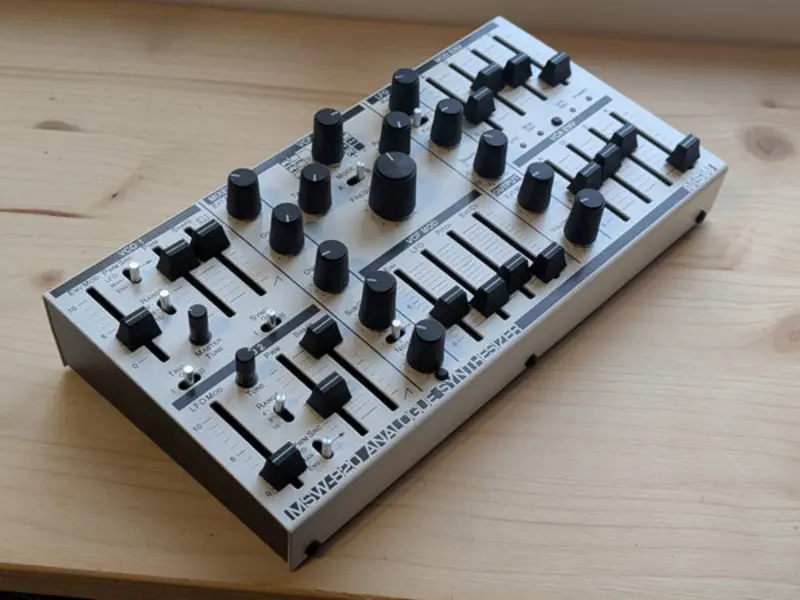
A Familiar Layout, Two Honest VCOs
The MSW-820 is a two-oscillator monosynth built around the AS3340 chip - the modern equivalent of the CEM3340 you'd find in a lot of late-period analogue classics. Each oscillator gives you saw and pulse waveforms, with octave ranges spanning 16', 8', and 4', and a seven-octave total span if you push it. PWM has its own fader and three modulation modes (envelope, manual, LFO), and OSC2 can either track OSC1's pitch or run free for detuned thickness.
The mixer section is where the design starts to feel generous. You get independent levels for both oscillators, a sub-oscillator that follows OSC1, and a noise source - but the noise isn't just one flavour. There are eight noise models tucked in there, including white, pink, hex invert, crackle, and a couple of pitched options called Orgone and Sonar. It's a small detail that adds a lot of texture to a synth that, on paper, looks like a straightforward subtractive box.
The Filter Is the Real Story
The voicing is built around the AS3109, paired with what Michigan Synth Works calls their Caveman Totem filter. The big trick is pole mixing - by reconfiguring how the four poles combine, the filter can deliver 16 different responses across low-pass, high-pass, band-pass, and all-pass behaviours. That's a lot of territory for one knob to cover, and it means a single patch can shift its character completely depending on which mode you choose.
It self-oscillates, of course, and frequency goes from 10 Hz right up to 20 kHz. Modulation sources include the envelope, the LFO, pitch tracking, an external CV input, and - more unusually - audio-rate modulation from OSC1 itself. That last one is the kind of feature that opens up FM-flavoured weirdness without leaving the analogue domain.
Modulation, Envelopes and Accent
Two independent envelope generators handle filter and amplitude duties, with attack times from 1.5 ms up to 2 seconds and release stretching to 10 seconds. That's a wide enough range to cover snappy plucks and slow swells without compromise.
The LFO runs from 0.1 Hz up to 22 Hz, which dips just into audio rate at the top end. There are eight shapes - the usual sine, triangle, square, ramp, and sawtooth, plus exponential decay, random, and a smoothed random. A crossfade between shapes is a nice modern touch, letting you blend between waveforms instead of stepping abruptly.
Then there's an accent function with two modes, affecting either the filter, the VCA, or both. It's controlled through an external modulation slider, which means it slots neatly into any sequenced workflow where you'd want classic accent-driven dynamics.
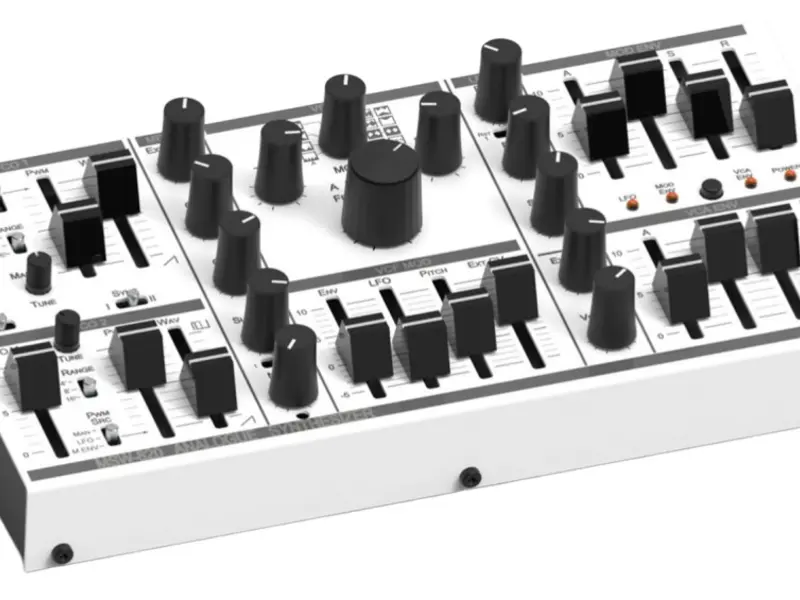
Built for Both Worlds
The MSW-820 comes in two flavours: a 220 x 120 x 50 mm desktop version, and a 46 HP Eurorack module for those of you who want to slide it straight into a system. Power is USB-C at 5V (only 200 mA, which is impressively modest), or the standard ±12V Eurorack rails for the modular version.
Connectivity covers the basics well. MIDI arrives via TRS 3.5 mm or USB-C, and there are dedicated jacks for clock, gate, V/Oct, external CV, and audio in. A nice touch is that the analogue inputs override MIDI data when patched, so you can move between studio sequencing and modular performance without reconfiguring anything.
The Honest Take
The MSW-820 isn't trying to be revolutionary. It's a well-built, fader-driven analogue mono with a familiar architecture and one genuinely clever twist in the filter. If you already own something Roland-shaped, you might wonder if you need this - but the 16-mode filter, the noise variety, and the audio-rate FM into the cutoff give it enough character to stand on its own.
What I like about Michigan Synth Works in general is that they're builders first. The MSW-820 carries that same spirit: practical decisions, thoughtful extras, no marketing-driven gimmicks. It feels like an instrument made by someone who wanted one for themselves, and that's usually the kind of synth that ends up worth living with.
More News
Notes
Burg: A Castle Full of Dirty, Patchable Sound
Stylophone DS-2: A Drone Box That Fits in a Eurorack