Rorschach: When Your Synth Starts Drawing
There's something satisfying about the idea that the music you're making can also be something you watch. Not a visualiser running on a laptop - something more immediate, more physical. The Rorschach from Lumatic Visual Devices is a small, handmade device that does exactly that: it takes the sounds and signals from your instruments and turns them into black and white video patterns in real time.
What It Is
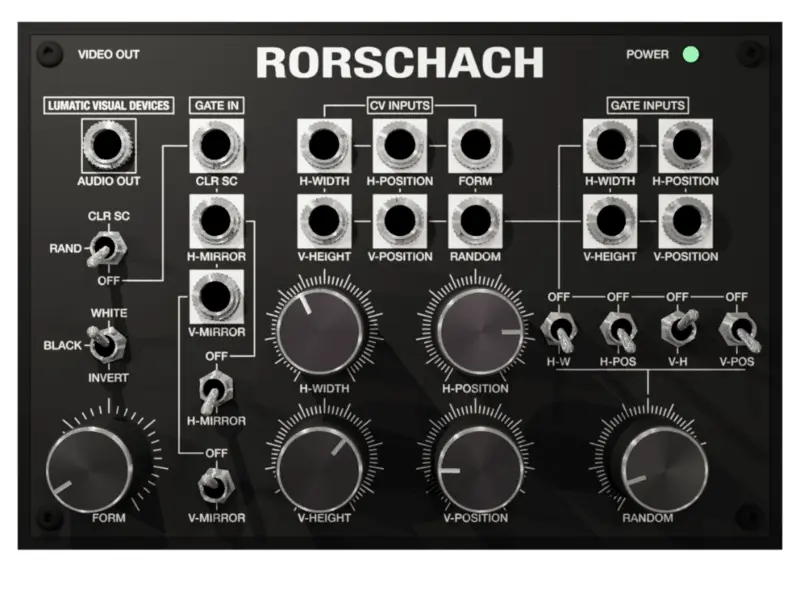
The Rorschach is an analog-style video synthesizer. It generates composite video output - the classic kind, the same standard as old CRTs and cheap monitors - in black and white. On its own, without any input, it already produces patterns. But the interesting part is what happens when you connect it to something else.
It accepts audio signals, gate signals, and CV (control voltage), meaning you can plug it directly into the output of a synthesizer, a modular system, or practically anything that produces a signal. As the music moves, the image moves with it. Gates trigger changes. CV shapes the patterns. All four main controls - horizontal position, vertical position, width, and height - have CV inputs, and there are six selectable pattern generator modes to choose from, each producing a distinct kind of shape. A dedicated random section lets the device generate patterns on its own, which you can then push and pull with incoming signals. The relationship between sound and image isn't predetermined - you work it out as you go, which is most of the appeal.
The People Behind It
Lumatic Visual Devices is a collaboration between Decadebridge, a small UK audio hardware manufacturer, and Mundane Consciousness, a visual artist and performer. They're based in the Cheshire-Staffordshire borderlands, and they build everything by hand. That background matters - this isn't a product designed at arm's length. It comes from people who actually use this kind of equipment in performance, which tends to show in the decisions made about what to include and what to leave out.
The name Rorschach is well chosen. The original Rorschach test was about finding meaning in abstract inkblot shapes - seeing patterns that aren't really there, or rather, that you bring to them yourself. The device works similarly. The patterns it generates are abstract, and what you see in them depends on you.
How It Fits In
The Rorschach works standalone, but it's particularly interesting in a modular or semi-modular context. If you're already working with Eurorack, you have gates and CV everywhere - the Rorschach just gives those signals a visual dimension. A kick drum trigger can now also be a visual event. An LFO can shape both a filter and a pattern on screen at the same time.
There's also something unexpected: the device has an audio output that converts its video signal into sound - a drone or noise texture derived from the same patterns you're watching. So the signal flow isn't strictly one-directional. Audio can feed into the visual, and the visual can feed back out as audio. That loop is unusual and worth experimenting with.
For live performance, this opens up something that's hard to achieve otherwise: a visual output that's genuinely reactive to what you're playing, not just looping on a screen behind you. The image and the sound come from the same source. They breathe together.
It's available in both PAL and NTSC formats, and it comes either fully assembled or as a DIY kit. It runs off a 9V battery or a standard wall adapter, which keeps the setup portable.
A Small Device with a Clear Purpose
What I find appealing about the Rorschach is how specific it is. It doesn't try to be a full video synthesis system or a software replacement. It does one thing - it takes your audio and CV signals and makes something visible from them - and it does it in a small, hand-built box that you can set up on a table next to your other gear.
The black and white composite output is a deliberate aesthetic choice as much as a technical one. There's something honest about it - no colour processing, no resolution arms race, just patterns and shapes that respond to sound. It sits in an interesting space between music hardware and visual art tool, and the people who make it clearly understand both sides of that.
If you've ever wanted the music you make to leave a visible trace in the room, the Rorschach is worth paying attention to.