Leploop: The Groovebox That Forgets on Purpose
There's a certain type of instrument that doesn't care about your plans. The Leploop is one of those. Built by hand in Italy by Tonylight and Peppo Lasagna under the LEP label (Laboratorio Elettronico Popolapre), it's an analog groovebox that treats instability not as a flaw but as the whole point. If you're the kind of person who likes their music a little unpredictable - who finds joy in sounds that evolve on their own - this thing is worth knowing about.
A Sequencer with a Memory Problem
The Leploop's most distinctive feature is its analog sequencer. It stores up to 16 notes in capacitors - yes, actual capacitors, not digital memory. And since capacitors discharge over time, the pitches you've programmed will slowly drift downward as you play. It's not a bug. It's the instrument breathing.
The sequencer gets its starting material from a sample-and-hold generator, which samples either white noise or an LFO to generate semi-random pitches. You capture what you like, and then you let it slowly wander away from where it started. The result is something closer to a living loop than a repeating pattern. Sound On Sound described it as "more like an analogue delay than permanent storage," which is a good way to think about it.
Alongside this, there's a four-track digital rhythm sequencer with up to 64 steps per track. Each track can run at a different clock division, so you can set up polyrhythmic patterns that shift and breathe alongside the drifting melodic sequencer.
Two Oscillators and a Bass Drum
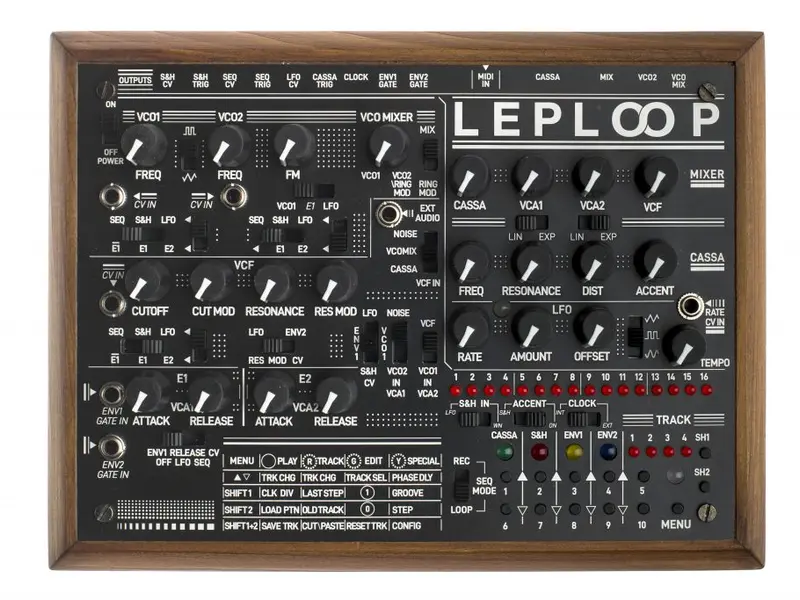
The synthesis side is straightforward but well-connected. VCO1 produces triangle and square waves, while VCO2 offers a sawtooth with ring modulation and FM from VCO1. A 24dB/octave diode ladder low-pass filter ties it together - it can be driven into a resonant wail that one reviewer memorably described as "a wounded cat", which sounds about right for what this machine is going for.
There's also a dedicated analog bass drum section called "Cassa", with its own audio output and CV input. Push the resonance high enough and it stops being a kick drum and becomes a continuous drone - a strange, bowed, almost didgeridoo-like tone that sits somewhere between percussion and synth voice.
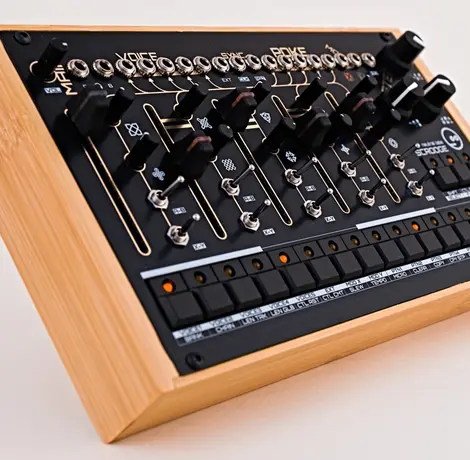
Two VCAs, each switchable between linear and exponential response, and dual AR envelopes with CV in and out round out the architecture. The connectivity is generous: nine 3.5mm CV/gate outputs plus full-size jacks, MIDI in for dual-channel sequencing and control, and DIN Sync. It connects well with modular setups and plays nicely with external gear.
Not for Everyone - and That's Fine
The Leploop lives in a wooden enclosure and uses a colour-coded LED menu system (off, red, green, yellow) instead of a screen. Navigation involves button combinations and switch toggling. It takes patience to learn, and it requires a certain tolerance for things not going the way you intended. Chris Carter of Throbbing Gristle, who knows a thing or two about unpredictable electronics, put it well: "it's very unpredictable and slightly unstable... but in a good way."
The third version of the Leploop (V3) brought redesigned PCBs, better-quality components, a refined power supply, and a new panel design by Italian studio IOSAGHINI. The build quality has improved since the early versions, though the instrument still rewards users who are willing to meet it halfway.
What It's Actually For
The Leploop is not a tool for building precise, repeatable arrangements. If you want quantised step sequences and locked-in grooves, there are much easier options. What the Leploop does well is something harder to find: it produces music that sounds like it's happening rather than being played back. The drifting pitches, the polyrhythmic triggers, the analog filter - together they create something that keeps changing even when you're not touching anything.
It's the kind of instrument that works best in live performance, where capturing an evolving moment matters more than reproducing it exactly. And in that context, the forgetting is the feature.
More News