Erica Synths EDU DIY Labor: A Breadboard Playground for Eurorack Experimenters
There is something refreshing about a piece of gear that openly invites you to take it apart and rebuild it. The EDU DIY Labor from Erica Synths is exactly that kind of device - a structured yet open-ended environment for learning electronics through doing, developed together with Dr. Shalom D. Ruben, a teaching professor of engineering at the University of Colorado.
A Breadboard With Infrastructure
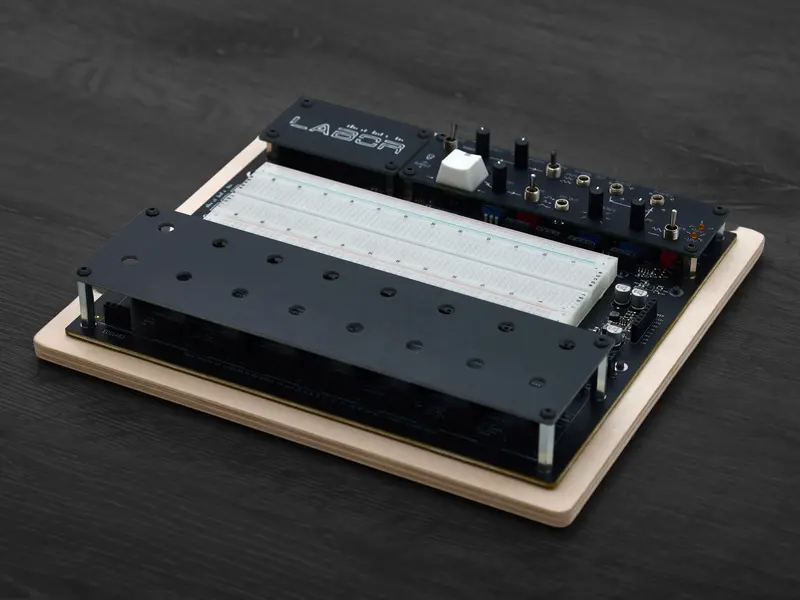
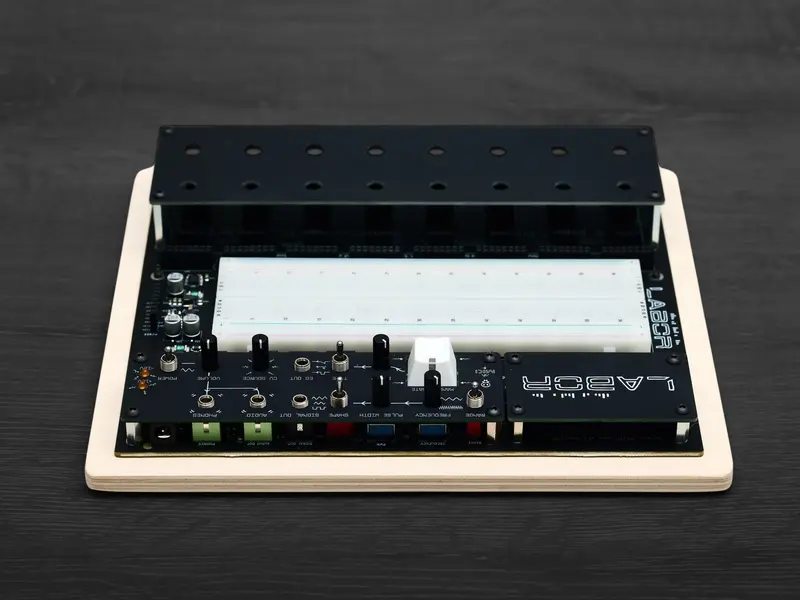
The heart of the Labor is a breadboard protected by a removable lid. On its own, a breadboard is just a grid of holes. What makes the Labor different is everything around it. There is a built-in dual power supply that delivers Eurorack-compatible voltages with overcurrent protection, so you can plug your breadboard experiments directly into a live circuit without a separate bench supply. A 16-slot modular interfacing section lets you mount potentiometers, jack sockets, and switches around the breadboard, turning your temporary circuit into something that actually feels playable.
This approach removes a lot of the friction that usually discourages people from experimenting. You do not need a rack of test equipment or a bench full of power adapters - the Labor gives you everything you need to go from a schematic to a working, patchable module.
Built-In Audio Blocks
To make things more immediately useful, Erica Synths included several pre-built audio components. There is a pulse/triangle/sine oscillator that works in both audio and LFO ranges, a multi-mode envelope generator with a premium push button, a buffered variable control voltage source, and an output amplifier with adjustable gain. A dedicated headphone output and a line-level output let you listen to and record whatever circuit you happen to be probing.
These building blocks serve two purposes. They give beginners a stable reference to compare against their own circuits, and they give more experienced builders ready-made signal sources to feed into original designs on the breadboard. You can, for example, use the built-in oscillator to drive a custom filter you have just soldered up on the breadboard, or patch the envelope generator through a transistor circuit you are still figuring out.
Expansion and Growth
An expansion slot allows for additional specialised prototyping tools to be added over time, which suggests Erica Synths intends the Labor to grow with its owner. The kit comes in two versions: a Basic Kit with the Labor unit, power supply, jumper cables, and an assortment of potentiometers, jacks, and switches; and a Full Kit that adds a wide selection of resistors, capacitors, ICs, and transistors so you can start building circuits right away without sourcing components separately.
Who Is It For?
The Labor sits in an interesting middle ground. It is not a beginner synth you plug in and play, nor is it a raw kit aimed only at seasoned engineers. It is a teaching tool that respects the learner's intelligence - it gives you real Eurorack voltages, real audio signals, and a real breadboard, then steps back and lets you explore. You can build your own filters, oscillators, envelopes, or sequencers on the breadboard, or follow one of the structured EDU kits that Erica Synths has developed to guide learners through specific topics in electronics and synthesis.
For anyone who has been curious about how Eurorack modules actually work from the inside, the Labor offers a genuinely hands-on answer. It will not hold your hand, but it will make sure you have the right tools to figure things out yourself - which is, arguably, the best kind of learning.
More News
Notes