The Drumboy Grows Up - and It Looks Like a Proper Groovebox Now
I have a soft spot for the original Drumboy. It was one of those small open-source devices that felt more like a maker project than a product - a flat little drum machine with touch buttons and an STM32 inside, sold for not much money, with the firmware sitting on GitHub for anyone to poke at. Fun, but limited. The kind of thing you keep on a shelf next to your soldering iron rather than on top of your studio desk. So when Randomwaves announced the Drumboy Pro back in January, my first thought was just to check whether they had finally added real buttons. They had. And then some.
What's Actually New
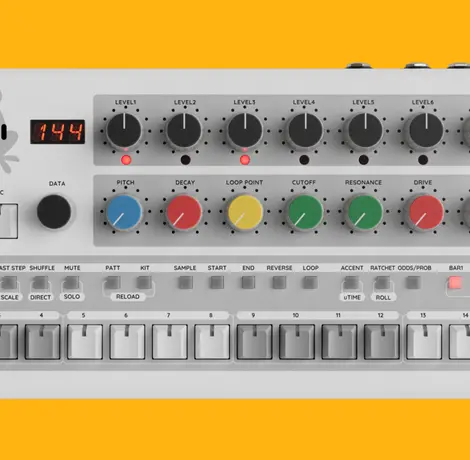
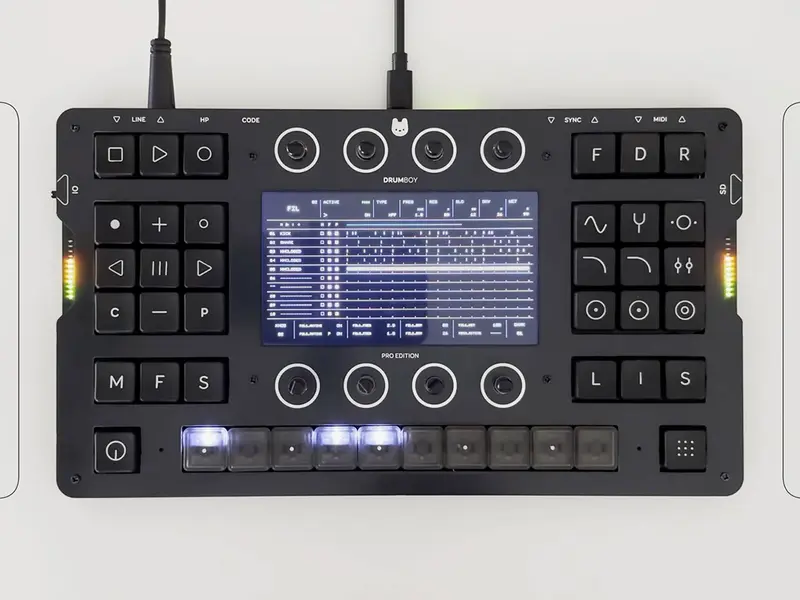
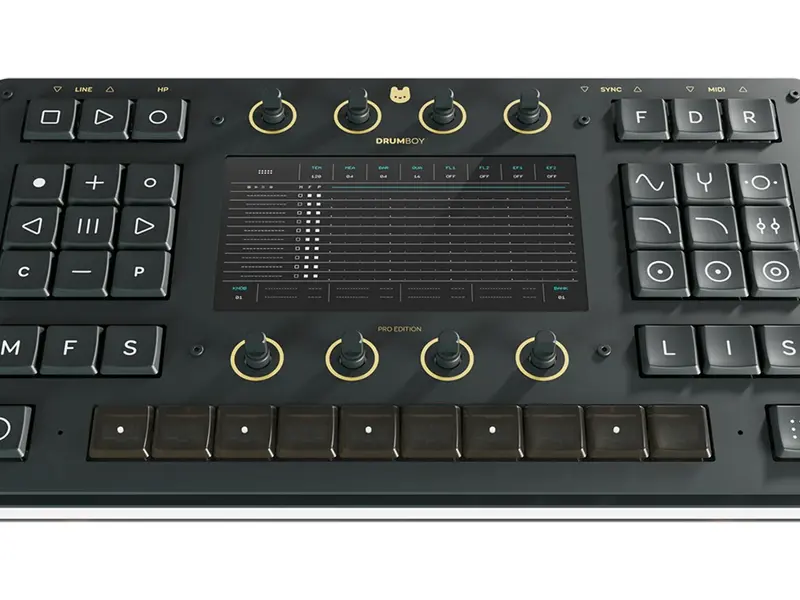
The short version is that almost everything has been redone. The touch-only surface of the Mini is gone - in its place are silent, low-profile tactile buttons that you can press without making your studio sound like a typewriter convention. There are eight rotary encoders sitting above and below a new 5.3-inch display, and those eight knobs can be mapped to up to ten banks of parameters. That gives you something like eighty hands-on settings without ever having to plug a mouse into the thing.
The sound engine is still sample-based, with ten layers, but the real-time access is what stands out. Level, pitch, playback direction, start and end points, bit rate, probability - all of it can be tweaked on the fly. There are two independent filter channels with low-pass, high-pass, band-pass and band-stop modes, plus a dual-channel FX engine with eight algorithms each: delay, chorus, flanger, phaser, compressor, expander, overdrive, and bitcrusher. A reverb sits on top of that, and ten assignable LFOs handle modulation.
It also has a battery now. The original didn't. Five hours per charge, via a charging pad, which is enough for a long train ride or an evening on the sofa.
The Sequencer and the Workflow
The bit I find most interesting is how the song layer has been rebuilt. Adding notes, deleting them, shifting them, adding probability, time-shifting - all of it is meant to happen without diving into nested menus. There's also a dynamic fill generator for pattern variations, which is the kind of feature that sounds gimmicky on paper but tends to be the thing you end up using the most when you're just trying to keep a loop alive for another sixteen bars.
What Randomwaves seem to have understood is that the Mini's problem wasn't its sound - the sample engine was always decent. The problem was that you couldn't really play it. You had to look at it, tap carefully, hope you hit the right area. The Pro is designed around the opposite idea: you should be able to keep your eyes on the screen and your hands on the knobs, and a beat should fall out of that.
Still Open Source
The thing I keep coming back to is that this is still an open-source instrument. The engine is open, the firmware will keep growing, and the broader Randomwaves ethos - small Istanbul-based outfit, STM32 platform, code on GitHub - is intact. Hardware grooveboxes at this kind of price almost never come with that. You usually pick: cheap and closed, or expensive and closed. Here you get something in between, and the fact that other people can write new features for it means the device might genuinely be more interesting in two years than it is on day one.
Worth Watching
The Pro is on Kickstarter now, with shipping estimated for August 2026, which - going by the usual rhythm of small hardware projects - probably means autumn at the earliest. There's the usual risk that comes with that kind of timeline, and the proof will be in how the firmware feels in the hand rather than in any spec sheet.
But the direction of travel is the right one. The Drumboy Mini was a charming gadget. The Drumboy Pro looks like a proper instrument - the sort of thing you might actually keep on the desk rather than the shelf. If they nail the workflow as well as the hardware, this could quietly become one of the more interesting small grooveboxes around.