Bastl Kalimba: A Hybrid Thumb Piano with FM and Physical Modelling Inside
Bastl Instruments has revealed the Kalimba at Superbooth 2026 - a portable hybrid instrument that plays like an acoustic thumb piano but hides a six-voice synthesizer under its 12 metal tines. The Czech company launched a Kickstarter campaign on 7 May, with the first batch of 1,500 units expected to ship in December 2026.
It's a notable shift in scale for Bastl. We've recently written about the Kastle 2 FX Wizard, the Kastle 2 Wave Bard and the Kastle 2 Alchemist - all pocket-sized patchable boxes. The Kalimba is a different proposition: a finished, standalone instrument designed to be picked up and played anywhere. It has a built-in speaker, a USB-C rechargeable battery, and an interface you play with your thumbs - no laptop, no patch cables, no power adapter required.
How It Works
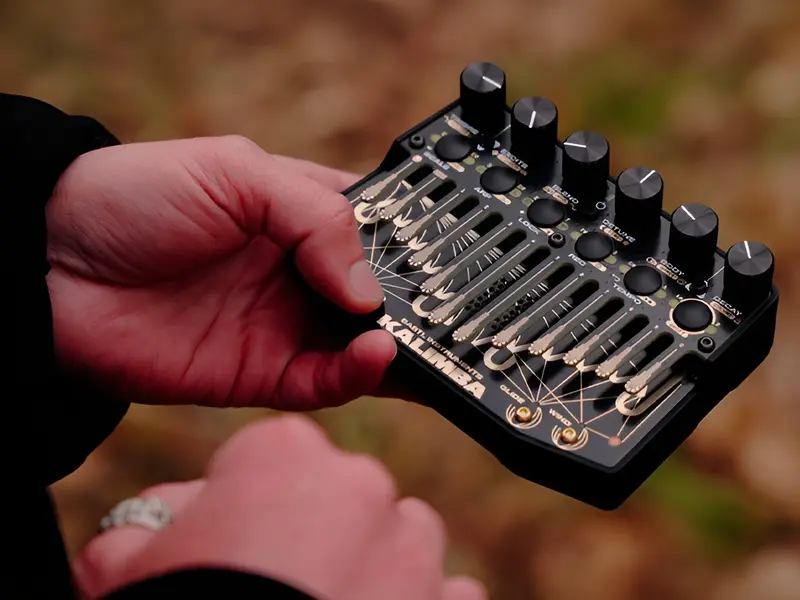
The 12 tines are touch- and velocity-sensitive. Plucking them sends signals from internal stereo microphones and capacitive sensors into two synthesis engines running in parallel: FM synthesis and a physical modelling engine with stereo digital resonators. The microphones pick up the acoustic vibration of the tines themselves, which means the instrument responds to how hard and how cleanly you play rather than just registering a note-on event.
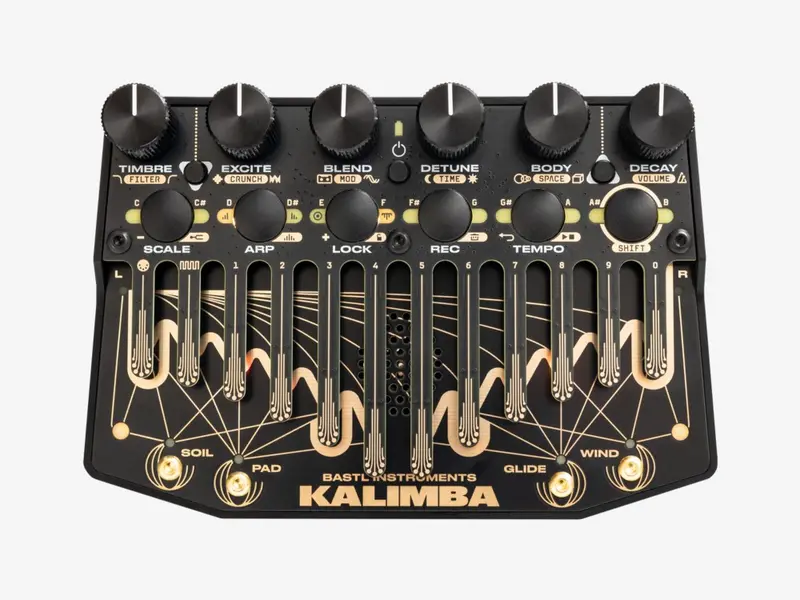
An internal accelerometer adds another layer. Tilting and rotating the device filters the channels and animates the sound dynamically, turning physical movement into an expressive parameter. Six bipolar knobs across the top handle timbre, excite, blend, detune, body and decay, and additional touch points - on the front and on the back of the case - cover pitch slides and two assignable functions.
Performance Features
The Kalimba isn't just an instrument with a sound engine bolted on; it has a small workflow built around it. There's an arpeggiator with five modes and a tempo divider, a looper with tempo-sync and time-stretch handling, 16 preset slots and 12 tuning scales with per-tine micro-tuning. The effects section covers reverb, delay, bit-crusher, distortion, chorus, flanger, tape emulation and filtering - a fairly complete palette for something this small.
Connectivity is handled through 3.5mm TRS MIDI in and out, USB-C MIDI, analog clock input and output, and a stereo headphone output. The same USB-C port charges the internal battery, so a single cable handles power, firmware updates and MIDI. The case measures 144 × 95 × 50 mm and weighs 310 grams - genuinely pocket-friendly - and a hardshell carry case is included to make travel easier.
Three Years In The Making
Bastl says the Kalimba took three years to develop, with multiple iterations on the casing, the tine materials and the interface. That long timeline is a useful piece of context: this is a more ambitious design than the Kastle line, and it sits in a small but growing category of synthesizers that take their playing mechanics from acoustic instruments. Korg's Phase8, also based on a kalimba-like layout, is the obvious comparison - and the two instruments seem aimed at slightly different players, with the Bastl leaning further into modulation, effects and standalone portability.
Pricing and Timing
The Kickstarter campaign runs until 6 June 2026. Pledge tiers start at €389 for the super early bird (500 units), then €420 for the early bird, €489 for the standard Kickstarter tier, and €500 for a special edition. Post-campaign retail is expected to land at €550 or above. The first 1,500 units are scheduled to ship in December 2026, with a second batch of up to 750 units following in early 2027.
For anyone who's followed Bastl's recent output, the Kalimba is the company doing something they haven't quite done before: a self-contained instrument with its own playing surface, designed to be picked up and played without patch cables, eurorack, or a host system. Whether it lands as a curiosity or as a serious performance tool will probably depend on how that microphone-driven excitation feels in practice - which is something we'll only really know once units start reaching backers.
More News
Notes
Burg: A Castle Full of Dirty, Patchable Sound
Stylophone DS-2: A Drone Box That Fits in a Eurorack