Kastle 2 Wave Bard: Patchable Sample Player Where Beats Emerge Naturally
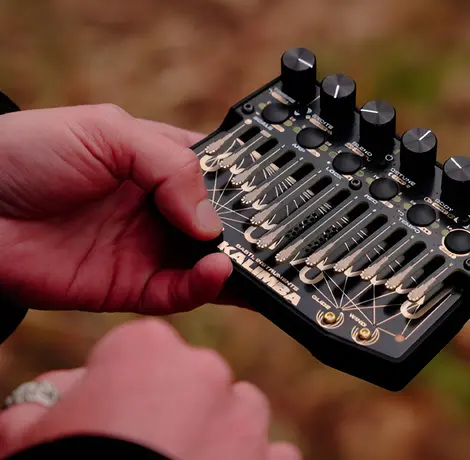
You know that feeling when you're just messing around with samples, tweaking knobs, and suddenly something clicks - a rhythm that wasn't there before, a melody you didn't plan? That's the whole philosophy behind the Kastle 2 Wave Bard. Bastl Instruments calls it "semi-autonomous", but I'd say it's more like a musical companion that keeps surprising you with ideas you didn't know you were looking for.
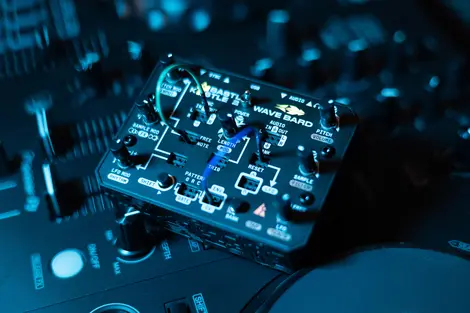
The Wave Bard is the latest addition to Bastl's Kastle 2 family - you might remember the Kastle 2 Alchemist we covered earlier, which focused on synthesis. This time around, they've built a sample player that fits in your pocket but packs some seriously clever features.
Sample Engine and Memory
At its core, the Wave Bard is a stereo sample playback engine running at 44kHz/16-bit. You get 89 seconds of mono or 44 seconds of stereo samples - and you can mix and match. Samples are organized in banks (6 factory banks by default, expandable to 32), with 8 samples per bank (adjustable from 3 to 32 in the web editor). Each bank gets its own color, so you always know where you are.
The factory sound bank comes from Oliver Torr, and it's worth exploring - but the real fun starts when you load your own samples through the web-based app. Just connect via USB-C, open the editor in your browser, and drag your samples in. The process is surprisingly smooth.
Pitch and Playback Control
The pitch control spans ±2 octaves (4 octaves total), and you can play samples either continuously or quantized to musical scales. There are two pitch modulation inputs: NOTE for quantized, scale-based pitch (updates on trigger), and FREE for continuous, unquantized modulation. You can define your own scales in the web editor.
Here's where it gets interesting: the LENGTH knob controls the sample envelope, but turn it counterclockwise and your samples play in reverse with an attack phase. During the attack, samples won't retrigger - which creates some beautifully smooth textures when you're cycling through sounds rapidly.
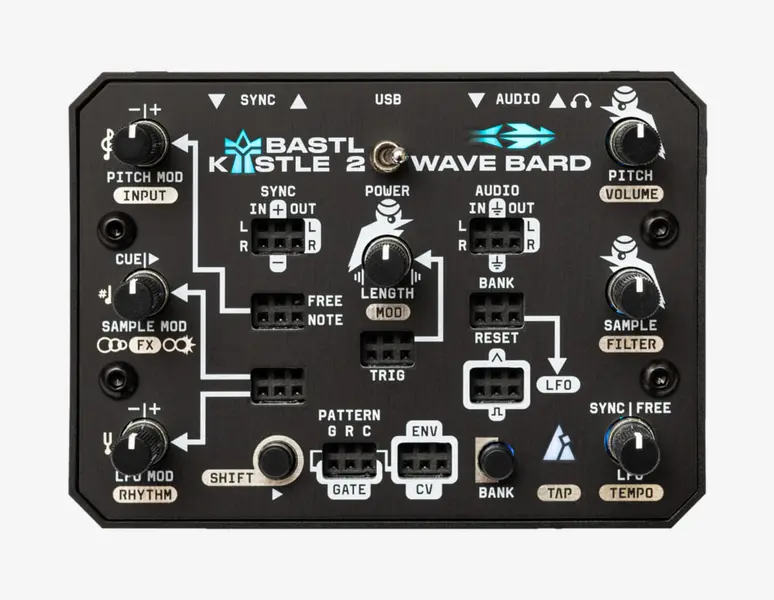
The SAMPLE knob lets you browse through the 8 samples in your current bank. Hit the SHIFT button to trigger the selected sample, or patch a signal into the TRIGGER input. The SAMPLE MOD input has two modes: PLAY mode where CV directly triggers samples, and CUE mode where CV aims at samples but waits for a trigger signal to actually play them.
Pattern Generator and Modulation
The built-in pattern generator is what makes the Wave Bard feel semi-autonomous. It runs on tempo-synced 16-step sequences, with separate GATE and CV outputs. The gate patterns are user-programmable through the web app - you can load preset rhythms or design your own.
The LFO offers triangle and pulse outputs with a reset input and attenuverting modulation. You can sync it to tempo or let it run free. When you start patching the LFO and pattern generator to pitch, sample selection, and filter inputs, that's when the Wave Bard starts generating ideas on its own. Set up a patch, let it run, and capture what emerges.
The manual puts it nicely: "Do not make beats - let them naturally emerge!"
Effects and Sound Shaping
A resonant filter offers both lowpass and highpass modes, letting you sculpt frequencies as samples play. The effects section gives you either stereo delay or a chorus/flanger chain, both tempo-syncable. The delay can create echoing rhythmic patterns, while the chorus/flanger adds movement and width.
You can also route external audio through the Wave Bard's effects. The stereo input accepts signals up to 6Vpp with adjustable gain (up to +12dB), and you can either mix external signals with the Wave Bard's output or process them through its effects chain.
Connectivity and Power
Despite its compact size, connectivity is comprehensive. Stereo output drives headphones up to 250 ohms. Analog sync input and output enable clock synchronization with other gear - the right channels of the sync jacks double as modular I/O connections for additional CV routing.
With the 1.1 firmware update, the Wave Bard now sends and receives USB MIDI bidirectionally. It accepts clock, notes, CCs, and pitch bend, while also functioning as a MIDI controller/sequencer sending data to DAWs or hardware instruments. This makes studio integration seamless.
Power comes from three AA batteries (rechargeable or standard) providing 15-18 hours of operation, or USB-C for longer sessions. The device draws 100-150mA, and low battery levels turn the backlight red.
Patch Programming Philosophy
The patchbay is where the Wave Bard really opens up. All main parameters can be modulated through 0-5 volt compatible connections. The layout encourages experimentation - patch the LFO triangle to pitch modulation, the pattern CV to sample selection, and the gate output to trigger, and you've got a self-playing sample sequencer.
Button combinations unlock secondary functions. Hold SHIFT while turning knobs to access volume, input gain, filter type, delay drive, and more. Hold BANK while turning knobs to adjust scale, root note, fine tuning, and octave. The interface rewards exploration without overwhelming you with menus.
Who It's For
The Wave Bard excels in several contexts. For traveling musicians and live performers, the battery operation and pocket size make it an always-available idea generator. Patch it into a modular setup and it becomes both a sound source and a powerful sequencer for external gear.
Electronic music producers working with portable setups will find it pairs naturally with devices like the Teenage Engineering PO series, Korg Volca line, or other Bastl instruments. The sync connections make integration straightforward.
Sound designers exploring generative techniques benefit from the semi-autonomous approach. Set up behaviors through patching, let the pattern generator do its thing, and capture the unexpected musical moments. The quantized pitch and programmable rhythms create structured randomness that stays musical.
In educational contexts, the visual patchbay makes sample manipulation concepts tangible. You can see and hear how modulation sources interact with sound parameters, which helps develop intuitive understanding of modular techniques.
Eurorack Version: Citadel Wave Bard
For those with modular setups, Bastl also offers the Citadel Wave Bard - a 16HP Eurorack module version with some notable differences. The Citadel features a full 3.5mm patch bay designed for Eurorack integration, additional switches for hands-on pattern generator control, and a reversible front panel that lets you swap between Wave Bard and FX Wizard firmwares via USB.
While the desktop Wave Bard excels at portability and battery-powered operation, the Citadel integrates the same core functionality into larger modular systems, serving as both a sample playback module and a utility hub with headphone output, TRS MIDI, tempo generation, and stereo mixing.
Final Thoughts
The Kastle 2 Wave Bard isn't trying to be a traditional sampler. It's not about precise editing or layering dozens of sounds. Instead, it's about discovering new rhythms and riffs through modulation and modularity. The "let beats naturally emerge" philosophy might sound like marketing speak, but when you're three patches deep and the Wave Bard starts generating patterns you'd never have programmed manually, it clicks.
If you're already into the Kastle 2 Alchemist, the Wave Bard makes a perfect companion - one handles synthesis, the other handles samples, and they share the same hardware platform with cross-compatible firmware.
Whether you're sketching ideas on a bus, building a portable performance rig, or exploring generative composition at your desk, the Wave Bard offers a distinctive approach to sample-based music making. It fits in your pocket, runs for hours on batteries, and keeps surprising you with fresh ideas. Sometimes that's exactly what you need.
More News
Notes