Embodme Erae 2: The Controller That Feels Like an Instrument
There's a certain moment with most MIDI controllers when you notice you're thinking about the interface rather than the music. You're hunting for the right pad, correcting a misfire, adjusting your grip. The Erae 2 from Embodme is designed to make those moments disappear.
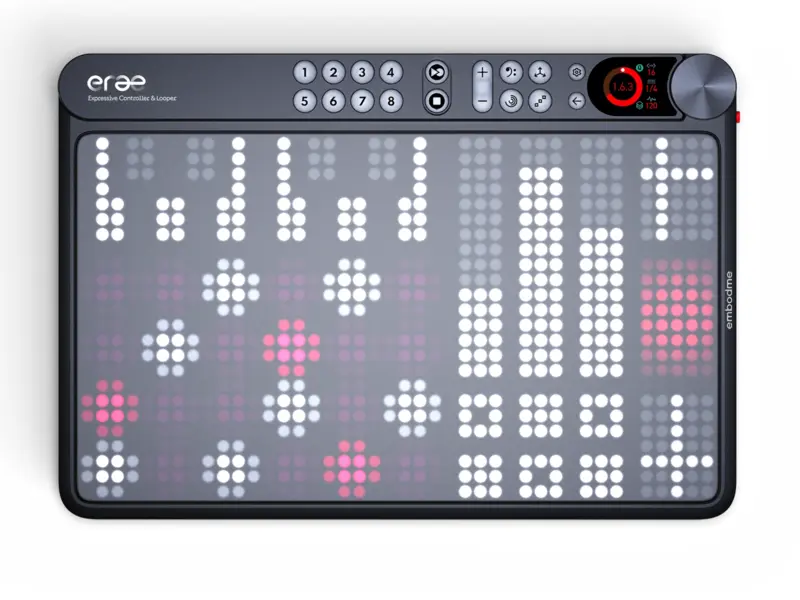
A Surface That Listens
The playing area of the Erae 2 is built around 16,000 force sensors packed into a 42×24 RGB LED grid. The result is a surface that registers not just where your finger is, but how hard you're pressing, and tracks all of that with sub-millimeter XY precision and a global latency under 1ms. This is full MPE (MIDI Polyphonic Expression) territory - each finger sends its own stream of pitch, pressure, and position data independently.
What makes the experience different from other MPE controllers is the fabric skin that ships with the device. It has a slight give to it, a softness that makes sliding across the surface feel natural rather than mechanical. Reviews consistently mention this as the thing that sets the Erae 2 apart - the way your finger sinks into the material changes how you play. It's not quite like pressing keys, and it's not quite like touching glass. It's something in between, and it works.
Shaping the Surface
The Erae Lab companion software is where you decide what your surface actually is. Keyboards, drum pads, faders, XY zones, note grids - you can drag and drop these into layouts, assign colours, define scales, and set up MIDI routing without writing a single line of code. The 42×24 LED matrix under the surface reflects whatever you've configured, turning the controller into a canvas that rearranges itself between songs.
There's also an optional drumming silicone skin for those who want something more resilient for stick playing. Two skins, one controller, and fairly different use cases covered.
The Looper
One of the bigger additions in the Erae 2 is the built-in MIDI looper. Eight tracks, with the ability to record full MPE gesture data - X, Y, and Z pressure - in polyphonic mode. You can set loop lengths, quantise, adjust tempo, and overdub additional layers. For live performance, this changes things considerably: instead of needing a laptop or a separate looping device, the Erae 2 handles it internally.
Into the Modular World
The connectivity on the Erae 2 is impressive for something positioned as a controller. Two USB-C ports (one host, one device), three MIDI connections via 3.5mm TRS, and - the standout feature for modular users - 24 configurable analog outputs. These can be set as CV, gate, trigger, or bipolar modulation, which means the Erae 2 can talk directly to Eurorack gear without any additional MIDI-to-CV converters. Patch a hand movement from the surface directly into a filter cutoff or an envelope trigger. It opens up a direct physical link between gesture and modular sound that's hard to replicate with standard MIDI.
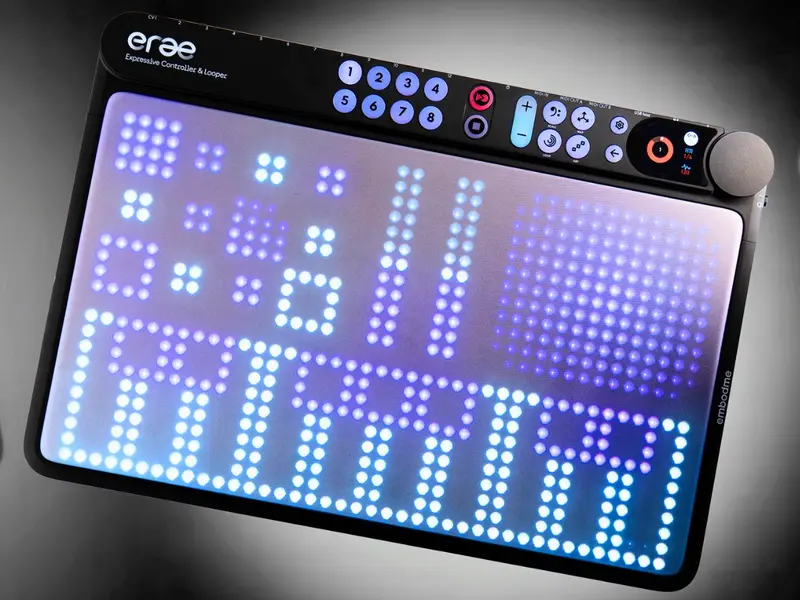
A Controller With Character
There's a built-in arpeggiator that responds to pressure - pressing harder changes the rate while simultaneously bending notes in polyphonic mode. It's a small detail, but it reflects the design philosophy well: controls that respond to nuance rather than just on/off.
The complexity is worth acknowledging. The Erae 2 is not a simple device to get started with. The customisation depth is one of its strengths, but it also means there's a learning curve - particularly around the Erae Lab software and working out how to build layouts that suit your playing style. First impressions from users consistently mention being initially overwhelmed before things start to click.
But that seems like a fair trade for a controller that genuinely feels like it's reaching out to meet you halfway.
More News
Notes