Terraphones Nymira: A Synth Built Around the Circle of Fifths
I've spent a lot of time around synths that put oscillators and filters front and centre, and almost none of them care how you find the notes in the first place. The Terraphones Nymira flips that around. It's a standalone instrument built around the circle of fifths, and the whole layout exists to make harmony easier to reach. That alone made me want to look closer.
The Concept
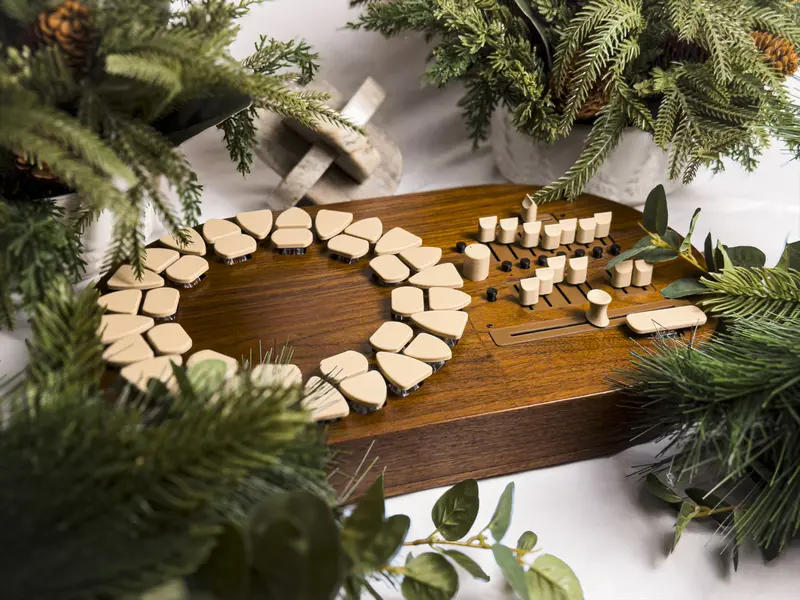
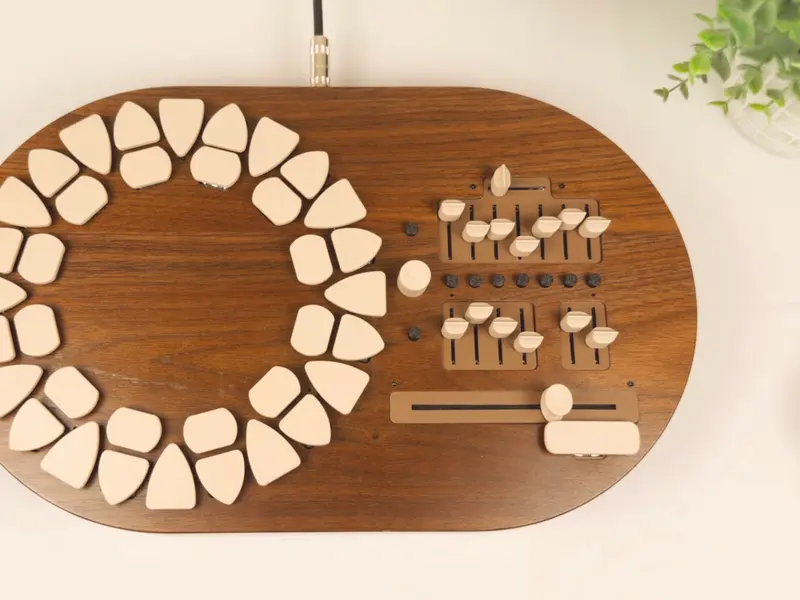
The idea behind the Nymira is simple to say and harder to build: take the circle of fifths, a piece of music theory most of us learned from a poster on a wall, and turn it into something you can actually press. The chord buttons sit in a ring. Major and minor triads live on the outer edge, while star keys handle diminished triads and extensions. A shift button lets you build chords note by note from a root.
What I like about this approach is that it rewards curiosity. Pressing a few buttons together gives you diatonic extensions - sevenths, ninths, sharp elevenths, thirteenths - without you needing to know the theory behind every one. Those are the chords that feel awkward to find on a keyboard or guitar, and here they fall under your fingers almost by accident. There's also a manual arpeggiator fader for strumming across the range, like a harp or a guitar neck stretched flat.
Three Sound Engines
The Nymira isn't just a clever controller. It makes its own sound through three different models, and each one gives the instrument a distinct character.
Additive FM is the main engine. It works from the overtone series and gives you control over seven individual partials through faders. This is where the instrument feels most like its own thing - bell-like, glassy, sometimes organ-like depending on how you balance the partials.
The subtractive model is the more familiar route. You get triangle, PWM, sawtooth, and sine/FM oscillators running into a low-pass filter, with detuning and frequency modulation per oscillator. If you want warmth or grit, this is where you go.
The granular model turns the engine into a granulator, with spray, grain size, and jitter controls. It's the one that pulls the Nymira away from "harmony machine" and towards texture and atmosphere.
A four-stage filter envelope (attack, cutoff, decay length, decay slope) and a built-in reverb with decay and dry/wet controls round things out. Function buttons let you toggle quantization, switch strum modes, and pick play modes like immediate trigger, bass line, or arpeggiator-only, plus close or open voicings.
Connectivity
For a small instrument, the back panel covers the basics well. There's a stereo 1/4" audio output and USB MIDI output, so the Nymira can play its own engines or drive other gear with the chords you find on it. That second part matters to me - the circle-of-fifths layout is useful even when you want a different sound source behind it.
Power comes from USB-C, accepting anywhere from 4 to 17 volts, or four rechargeable AA batteries. That makes it genuinely portable, which is rarer than you'd think for an instrument this expressive.
Build Quality
This is where the Nymira stops feeling like a product and starts feeling like an object someone cared about. It's hand-assembled by Thomas Adam Billings, and the enclosure is solid walnut sourced and milled in the United States. The keys use Cherry MX Silent Red switches, so the chord buttons have a real, quiet click to them.
The detail I keep coming back to is the pair of internal surface transducers. They turn the walnut body into an acoustic resonator, so the wood itself adds to the sound. Most synths treat the case as a box to hide circuitry in. Here it's part of the instrument.
Who It's For
The Nymira sits in an interesting spot. It isn't a budget noisemaker, and it isn't a flagship workstation either - it's a small-batch, boutique instrument made in limited numbers. That places it next to things like the Akuto Studio Chord Machine or other harmony-focused controllers, but the Nymira's onboard sound engines and resonant wooden body set it apart.
I'd point it at a few kinds of people. Songwriters who want to discover progressions rather than program them. Producers who already know theory but want a faster, more physical way to reach for extensions. And anyone who values an instrument they can pick up, run on batteries, and play on a sofa without booting a laptop. If you mostly need a deep modulation monster or a polyphonic romper, this isn't that. But if the act of finding chords is where your music starts, the Nymira is built for exactly that moment.