Loess Labs Quad Creek - Filter Pinging as a Way of Life
There's something genuinely refreshing about a synthesizer that throws out the oscillator playbook entirely. The Quad Creek from Loess Labs doesn't generate sound the way most analogue synths do - instead, it relies on filter pinging, a technique where short pulses excite resonant filters into producing tones. If you've ever heard of the Meng Qi Wing Pinger, you'll recognise the family resemblance, but the Quad Creek takes the concept further with four independent voices and a generous helping of CV routing.
Four Creeks, Four Voices
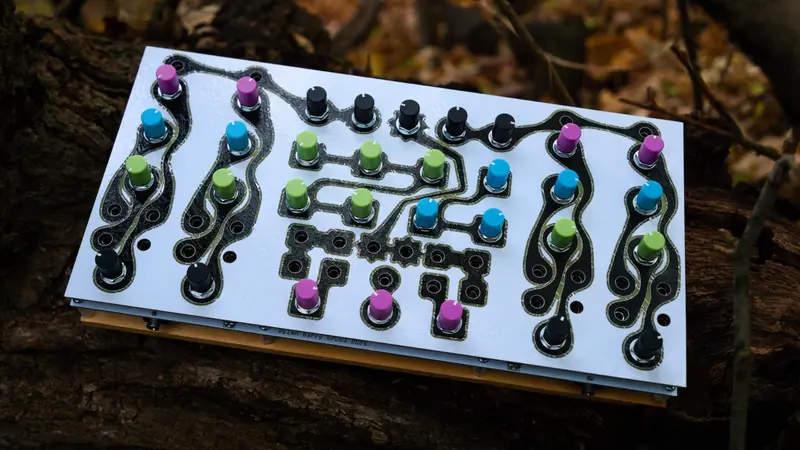
The heart of this instrument is its four "creeks" - resonant band-pass filters, each with its own integrated pulse interpreter. Every creek has three colour-coded controls: blue for frequency, purple for resonance and decay, and green for ping rate. That's your basic palette for each voice, and it's surprisingly expressive. Dial up the resonance and you get sustained, singing tones. Pull it back and the pings become short, plucky percussive hits. Adjust the frequency and you're essentially tuning each voice across a wide range.
Each pulse interpreter has its own clock input and riser output, which means you can synchronise voices or let them drift apart into polyrhythmic territory. This is where the Quad Creek gets really interesting - four independent filter voices running at different rates and pitches can quickly build up complex evolving patterns that feel organic rather than mechanical.
The Glue in the Middle
Between the four filter voices sits a generous collection of CV utilities. There's a sine LFO running from 0.1 to 12 Hz, dual pulse generators with subdivision capabilities, and - perhaps most fun of all - a white noise percussion engine with dual CV inputs for generating complex rhythmic patterns on its own.
Two step sequencers round out the modulation options: a 5-step and a 3-step, both with directional control. Patch these into the filter frequencies and you've got melodic sequences emerging from what is essentially a box of filters and gates. No oscillators needed.
Mixing and Connectivity
The Quad Creek includes a 5-channel mixer feeding three stereo outputs, plus two stereo inputs for processing external audio. Run a drum machine through it, patch in another synth, or use it purely as a standalone voice - the routing options are flexible enough to fit different setups.
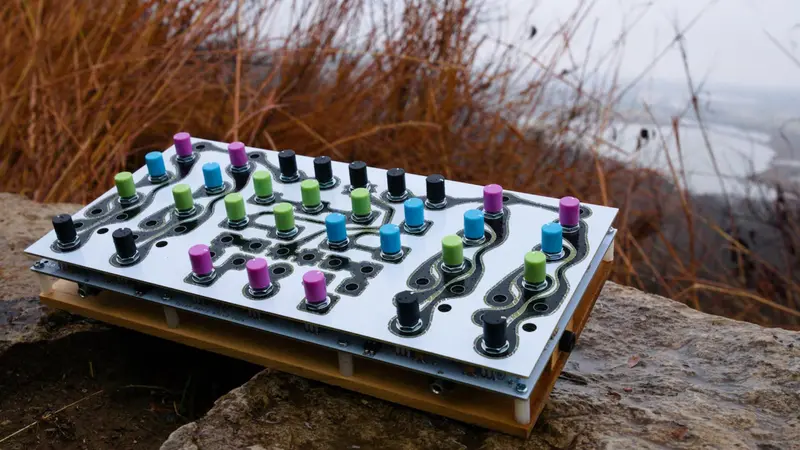
One thing worth noting is the patching format: the Quad Creek uses 4mm banana connectors rather than the more common 3.5mm mini-jacks found on most Eurorack gear. Audio I/O is handled through 3.5mm stereo jacks, so connecting to your mixer or audio interface is straightforward. The banana patch system keeps things colourful and tactile, and makes quick patching feel immediate.
Open Hardware, Open Spirit
The whole instrument runs on a unipolar design with a 0V to +9V range, powered by a simple 12V DC adapter. Dimensions are compact at roughly 11 by 5.5 inches - small enough for a desktop setup but large enough to give your fingers room to work.
What really stands out about the Quad Creek is that it's released as free hardware under the GNU GPLv3 licence. Schematics and gerber files are publicly available, so if you're handy with a soldering iron, you can build your own. Loess Labs offers the instrument as a fully assembled unit, a DIY kit, or PCBs only - a range of options that reflects the open-source ethos behind the project.
The Quad Creek sits in that sweet spot where experimental meets approachable. Filter pinging isn't new, but having four voices of it with integrated sequencing and modulation in a single box makes it feel like a proper instrument rather than a novelty. It's the kind of synth that rewards patience and curiosity - patch something in, twist a knob, and see where the creek takes you.
More News
Notes