Void9 Mõnai: A Portable Multitimbral Synth from Iceland
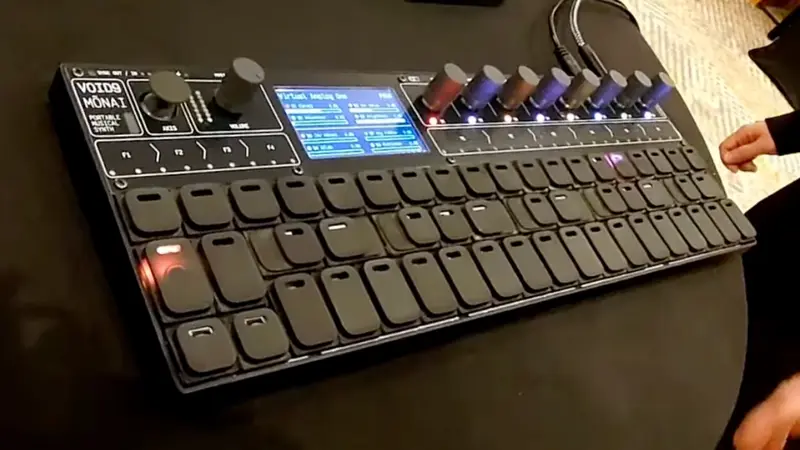
Void9 is a new name in the synthesizer world, but they are not starting small. The Reykjavik-based company unveiled the Mõnai at the Audio Developer Conference 2025 in Bristol, and it immediately caught attention. A portable, battery-powered, multitimbral synthesizer with four sound engines, a proper keyboard, and an open SDK - all packed into a CNC-machined aluminium enclosure that fits in a backpack. It sounds almost too good to be true, but the prototype they showed was very much real.
Four Engines, One Box
The Mõnai runs up to four sound sources simultaneously, each with its own effects chain and modulation routing. The available engines include virtual analogue synthesis, DX-style FM variants, drum synthesis, and real-time sampling through a line input or the two built-in microphones. Each of the four layers gets a dedicated sequencer that supports both real-time and step recording - and these sequencers can also trigger external gear, so you can mix internal and external sound sources freely.
This kind of multitimbral architecture in a portable device is unusual. Most instruments of this size force you to choose between being a synth or a groovebox. The Mõnai tries to be both, and based on the specs, it might actually pull it off.
The Control Surface
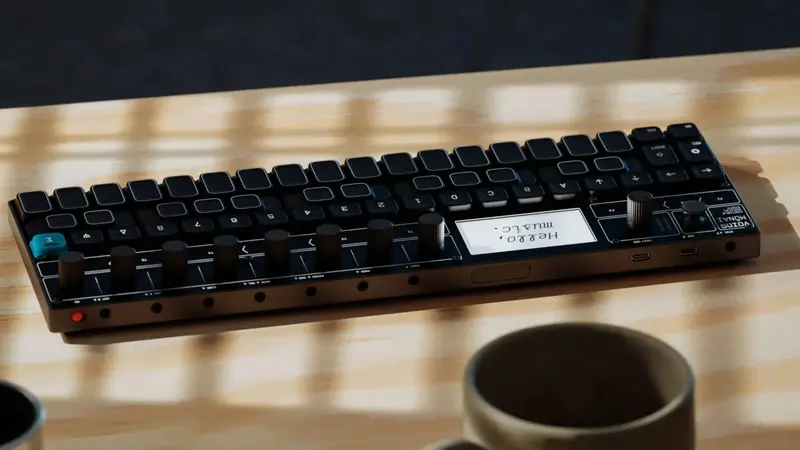
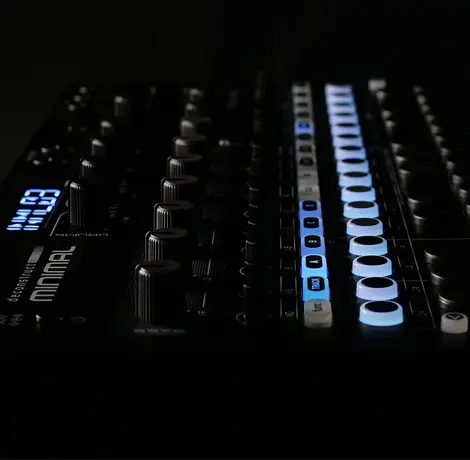
The interface is dense but well-considered. You get 29 velocity-sensitive piano keys spanning just over two octaves, plus 23 function keys. Eight endless encoders provide tactile feedback, and there are two touch-sensitive strips - an 8cm modulation strip on the left and a 20cm multi-touch strip on the right. A 2-axis joystick sits on the left side for real-time expression, and there is even a 6-axis motion sensor built in.
Visual feedback comes from a 3.1-inch LCD display and 109 LEDs (88 RGB, 21 single-colour). The whole thing measures 36.5 x 12.3 x 18.7 cm - roughly the size of a large book.
Connectivity
For a portable device, the Mõnai is surprisingly well-connected. Two audio outputs, an audio input for sampling, 3.5mm MIDI in and out, two USB-C ports (one for charging and computer connection, one as a USB host for MIDI controllers), a pedal input, sync in and out, and four CV outputs covering pitch, modulation, velocity, and gate. That last bit means it can integrate directly with modular setups - a nice touch for a battery-powered instrument.
The SDK Promise
Perhaps the most intriguing aspect of the Mõnai is the planned SDK, set for Q2 2026. Void9 wants third-party developers to create custom synthesizer engines, filters, effects, and sequencing tools for the platform. It is similar in concept to Korg's logue SDK, though details on how open it will actually be remain to be seen. If it works as intended, it could give the Mõnai a much longer shelf life than most hardware synths.
Still a Prototype
It is worth being clear about this: the Mõnai is still in development. Void9 is targeting a beta release in Summer 2026, with a full release likely later that year. There is no confirmed pricing yet, and much can change between a conference demo and a shipping product. The community has drawn comparisons to Teenage Engineering's OP-1 and OP-XY, and the ambition is certainly there. Whether Void9 can deliver on all these promises as a new company remains the big question.
That said, the prototype shown in Bristol looked solid, and the spec sheet is genuinely impressive. If you are in the market for a portable music workstation and do not mind waiting, the Mõnai is definitely one to keep an eye on.
More News
Notes