Oddment ODD-1 - A Granular Modulation Lab That Fits on Your Desk
Granular synthesis has been living inside laptops and Eurorack modules for years, but dedicated hardware boxes that really commit to it are still rare. The ODD-1 from Oddment Audio - a small team based in Traverse City, Michigan - is trying to change that. It's a desktop grain synthesiser with a touchscreen, 16 encoders, and a modulation system deep enough to make your head spin. Previously known as "Groc", the ODD-1 has been quietly building attention in the synth community, and for good reason.
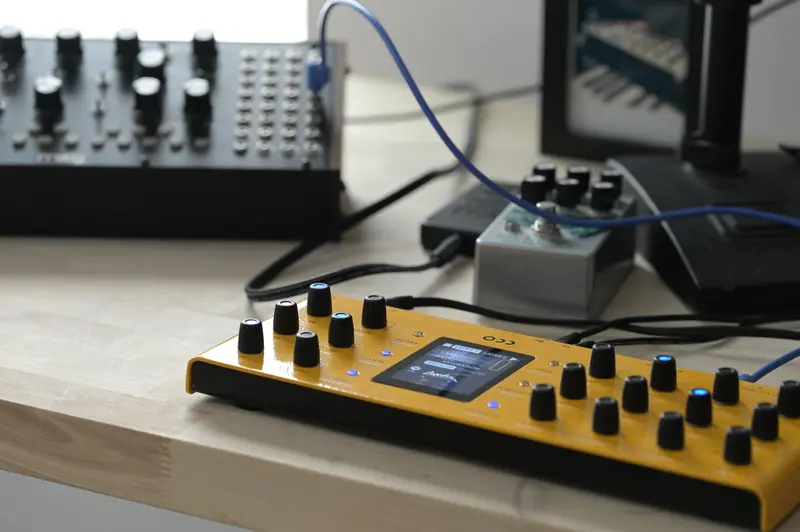
What Makes the Grain Engine Special
At the heart of the ODD-1 is a custom granular engine with a variable-speed time path. Four independent playheads can move forward, backward, freeze, or mix directions simultaneously - and pitch and time operate completely independently. That's the kind of flexibility that lets you stretch a two-second vocal sample into an evolving ambient landscape or chop it into stuttering rhythmic fragments.
Each grain gets its own spatial treatment through a binaural spatialiser, plus an optional auditory-inspired bandpass filter. You can adjust grain size, spacing, shape, and stereo placement, all with randomisation options to keep things organic. The oversampling quality for time and pitch manipulation is reportedly high, which helps avoid the gritty artefacts that sometimes plague granular processors.
The dual-layer architecture is worth highlighting: two independent polyphonic layers, each with its own 60-second stereo sample buffer. You can load factory samples, upload your own WAV files, or sample directly into the device. This effectively gives you a multi-timbral synth, a looper, and an effects processor running at the same time.
Modular Thinking in a Compact Box
The ODD-1 is organised like a rack-mounted modular system, laid out in rows on the touchscreen. Every parameter becomes a modulation destination, and the list of sources is generous: three ADSR envelopes, four multi-wave LFOs, four macro controllers, four analogue CV inputs, and full MIDI integration including velocity, polyphonic aftertouch, pitch bend, mod wheel, and CC learning. That's over 16 modulation sources driving more than 100 destinations.
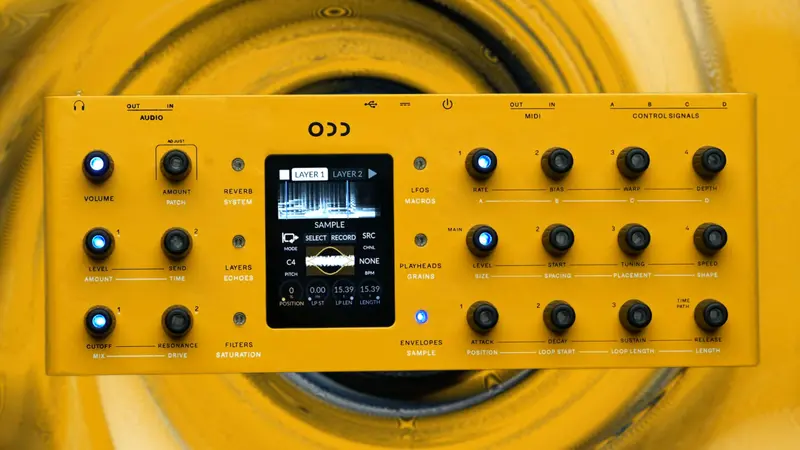
The 16 encoders handle primary and secondary parameter control, with a shift button for accessing deeper functions. There's no menu diving required for the most common operations - the touchscreen provides real-time visualisations of the grain process, modulation plots, and effects routing. One early observer described the layout as "really, really clever and well laid out", noting how the modulation system stays accessible without burying things in submenus.
Effects and Processing
Beyond the grain engine, the ODD-1 packs a multi-effects section with resonant multimode filters (lowpass, highpass, bandpass, band-reject), distortion, bit-crushing, compression, delay, and reverb. Two echo paths can be configured in series, parallel, split, or ping-pong modes, and each includes a harmoniser. The filters can run in serial or parallel configurations too - useful for carving out space in layered patches or adding movement to drones.
Connectivity
The ODD-1 covers a lot of ground in a small footprint. There's a 3.5mm headphone output, balanced stereo line input and output, MIDI in/out on mini-jacks, USB-C for power and multi-channel audio, and four configurable control signal inputs that accept pedals, switches, CV, or gate signals. The USB-C connection also handles audio streaming to and from a computer, so it can slot into a DAW setup without extra hardware.
Under the hood, it runs on a quad-core ARM Cortex A-72 processor with 1 GB of RAM and around 3 GB of user storage on top of a 2 GB factory sample library. Audio processing runs at 32-bit with support for 44.1, 48, and 96 kHz sample rates.
Who Is This For
The ODD-1 sits in an interesting spot. It's not a simple granular pedal or a stripped-down looper - it's a proper sound design station that happens to be portable. If you're already deep into granular territory with software like Granulator or hardware like the Tasty Chips GR-1, the ODD-1 offers a more hands-on, patchable alternative with the touchscreen giving immediate visual feedback.
It could also appeal to ambient musicians, sound designers, and live performers who want deep granular processing without being tethered to a laptop. The modular-style routing and CV inputs mean it can integrate with Eurorack systems, while the MIDI and USB connectivity keep it relevant in more traditional setups.
The ODD-1 is currently available for pre-order with a refundable deposit, with beta units expected to ship in May 2026 and general availability planned for September 2026.
More News
Notes