Kastle 2 FX Wizard: Nine Effects and a Patchbay in Your Pocket
There's something almost unreasonable about what Bastl Instruments keeps putting into these little boxes. We've already written about the Kastle 2 Alchemist and the Kastle 2 Wave Bard, and every time I look at another Kastle 2 device, I have the same reaction: how much is actually in here?
The FX Wizard is the effects-focused member of the family. Where the Alchemist generates sound and the Wave Bard plays samples, the FX Wizard processes anything you send into it - and does it in stereo, with a surprising amount of depth for something that runs on three AA batteries.
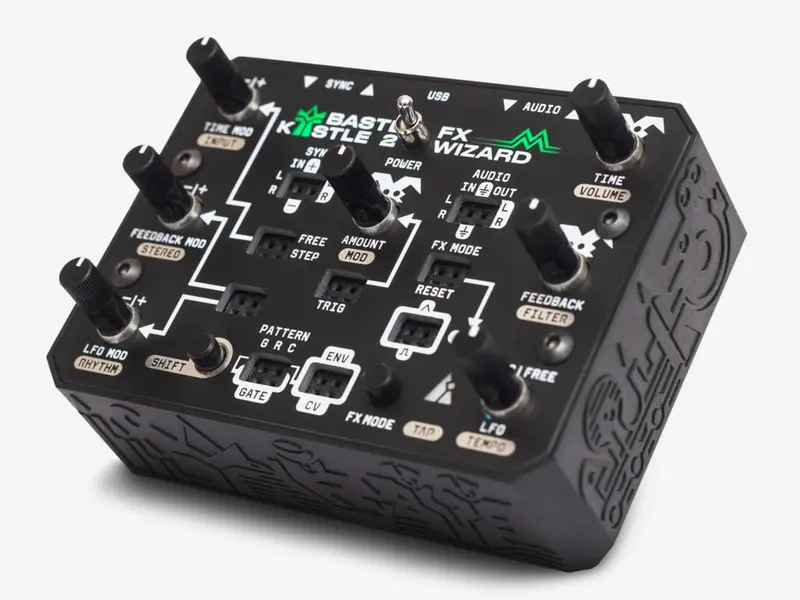
Nine Effects, Three Families
The FX Wizard organises its nine modes into three groups. The Delay family covers the classic ground: a stereo delay with up to 1.15 seconds of time, a flanger that can drift into stereo chorus territory, and a Freezer that captures and holds audio moments. The Freezer, in particular, has a way of becoming unexpectedly addictive - trapping a snippet of sound and letting it loop while you throw chaotic feedback at it is a very specific kind of fun.
The Amplitude family handles dynamics and rhythm: an autopanner that can push into ring modulation, a digital crusher with feedback, and a slicer for carving out rhythmic transients. The Pitch-Shifting family rounds things out with a Pitcher for tonal or rhythmic pitch work, a Replayer that introduces reversal and pitch-shifting artifacts, and a Shifter for detuned sounds and feedback slopes.
Each mode has its own personality. Some are immediately musical, some are immediately strange, and a few - like the Replayer - exist somewhere in between. That range is part of the appeal.
The Patchbay is the Point
The FX Wizard has 54 patch points across nine blocks, and this is where the device stops being just an effects box and starts being an instrument. The built-in modulation sources - an LFO with triangle and pulse outputs, an envelope follower, and a pattern generator with gate and CV outputs - can be routed into the effect parameters through the same tiny jumper cables that come in the box.
Patch the envelope follower into the filter in the feedback loop and the effect starts responding to your playing dynamics. Patch the pattern generator's gate output to the sync input and the delay or slicer locks to a rhythm. Patch the LFO into the feedback amount and things get unstable in interesting ways. Sound on Sound summarised it well: once you start applying modulation, the box can "morph into a weird wizardly instrument of its own."
Yes, the patch cables are small. Yes, your fingers will protest. That's part of the deal with Kastle devices - the fiddliness is real, but it's also the thing that makes you slow down and pay attention to what you're actually connecting.
Works With Everything
The FX Wizard is genuinely easy to slot into a setup. Stereo in, stereo out, headphone-capable output (up to 250 ohm), analog sync in and out for locking to external gear. The input accepts signals up to 6Vpp with up to +12dB of gain, so it handles both line-level and modular signals.
Since firmware 1.3, it sends and receives USB MIDI - clock, notes, CCs in both directions - which opens up control from a DAW or hardware sequencer. From firmware 1.6 onwards, rhythm patterns and sequencer step counts can be edited through a web-based app, which also enables polyrhythmic configurations beyond the standard step counts.
The connection to other Kastle 2 devices is worth noting: the FX Wizard shares the same hardware platform, so pairing it with the Alchemist or the Wave Bard feels natural. One generates the sound, the other shapes it - and both understand the same sync and CV signals.
Battery Life and Portability
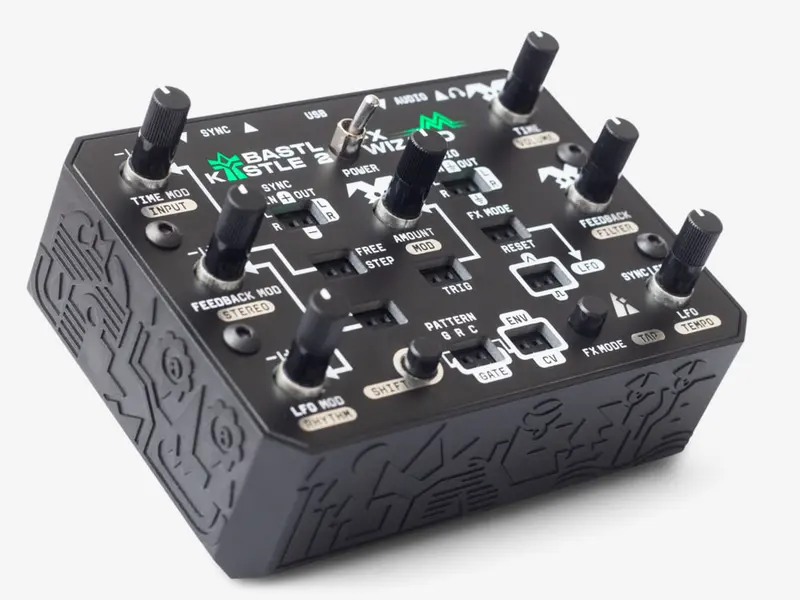
Three AA batteries last 15 to 18 hours. USB-C works as an alternative power source and handles firmware updates. There's no battery cover - it's that kind of device, pragmatic about form factor in a way that prioritises what matters.
It processes audio at 16-bit / 44kHz. That's not a limitation so much as a character choice; the digital crusher and some of the more aggressive feedback configurations will remind you there's a specific flavour to this resolution.
Worth the Patience
The Kastle 2 FX Wizard isn't the quickest effects unit to reach for when you want a clean reverb or a tidy delay. But if you're drawn to the idea of a stereo multi-effects box that actively encourages you to patch modulation sources into its parameters, set rhythms running, and see what happens - it's genuinely hard to put down. The nine effects cover a lot of sonic territory, and the patchbay turns all of it into something considerably more interesting than a preset-based box ever could be.
More News
Notes
Burg: A Castle Full of Dirty, Patchable Sound
Stylophone DS-2: A Drone Box That Fits in a Eurorack