Fors Junior: Lo-Fi Game Boy Charm Meets Modern Synthesis
For those who grew up making music on a Game Boy with Little Sound DJ or nanoloop, there's something magical about those lo-fi tones. Swedish developer Fors - the team behind Fors Pivot - has just released Junior, a plugin that captures that raw 4-bit character while expanding it into a fully capable modern synthesizer.
Classic Soundchip, Modern Design
Junior takes inspiration from the Nintendo Game Boy soundchip without trying to be a strict emulator. It balances accuracy and fun, giving you that distinctive chipmusic character while removing the hardware limitations that made the original frustrating to program.
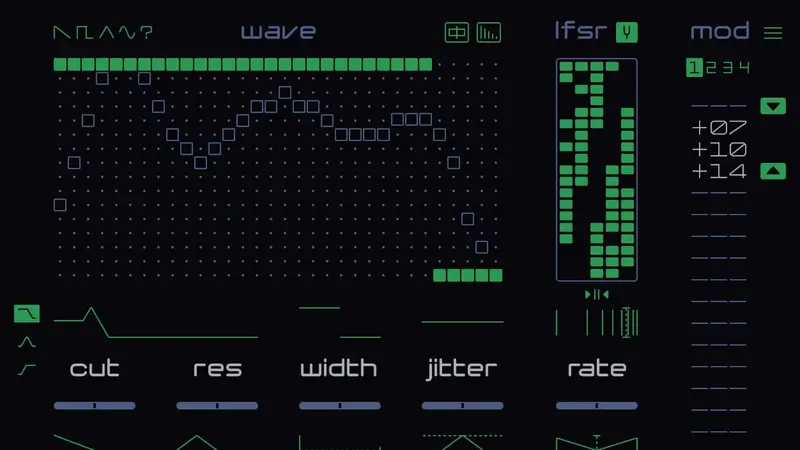
At its core is a 4-bit wavetable buffer - 32 values that you can draw directly on a dot matrix display. This works just like the Game Boy's wave channel, but Junior lets you transform that buffer in real-time with various sound shaping controls. You can apply resonant filters, pulse width effects, wavefolding, and even simulated oscillator sync - all operating directly on the buffer data.
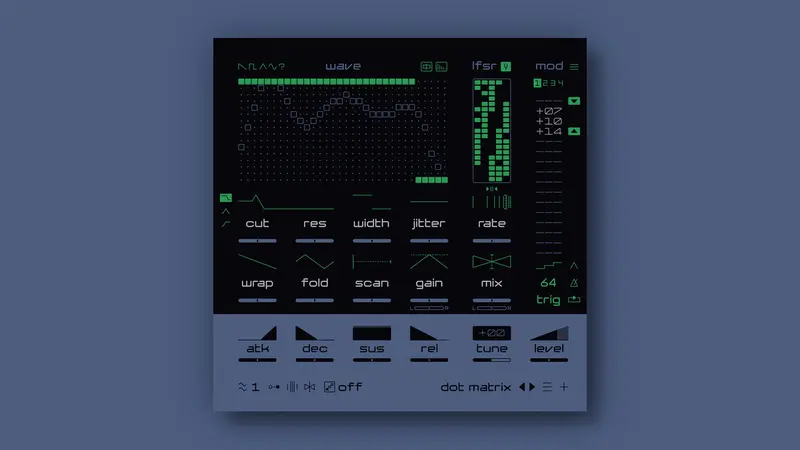
The interface shows your waveform as it gets transformed, with hollow blocks indicating the difference between your original drawing and the applied effects. It's visual, immediate, and satisfying to tweak.
Tables: Tracker-Style Modulation
One of Junior's most interesting features is its four "Table" modulators. These are 16-step sequencers inspired by modulation tables in tracker software like M8 and Defmon. Each table can function as an LFO, envelope generator, arpeggiator, or even a MIDI mapping tool.
You can set tables to trigger per note, run freely like an LFO, step through manually, or index through values based on MIDI input (velocity, mod wheel, or MPE data). The interpolation control lets you smooth between steps, so you can create everything from stepped arpeggios to flowing breakpoint envelopes.
Every modulatable parameter has individual depth controls for all four tables, allowing for complex layered modulation that would be difficult in many other synths.
Noise and Character
Beyond the wavetable oscillator, Junior includes a 7-bit LFSR (Linear Feedback Shift Register) noise generator - the same type used in the Game Boy. This produces characterful lo-fi noise that can be noisy and chaotic in Wide mode or more tonal and metallic in Narrow mode.
The Rate control changes the noise pattern from dark to bright, and with keytracking enabled, you can create pitched noise for percussion, textures, and sound effects. The Mix control lets you blend between the wavetable and noise sources.
Modern Features
While Junior embraces lo-fi aesthetics, it doesn't skimp on modern functionality. You get up to 16-voice polyphony, stereo unison with spread control, and note glide. In mono mode, there's a chipstyle arpeggiator that triggers on overlapping notes.
The synth supports MPE continuous pitch bend (±48 semitones), CLAP Note Expressions, and ODDSound MTS-ESP for advanced tunings. The interface is fully scalable with customizable color themes, and there's even a random preset generator for instant inspiration.
Versions and Compatibility
Junior comes in two versions: the full version and Junior-Lite as a free download. The Lite version includes everything except the noise generator and the four modulation tables - perfect for trying out the core wavetable engine before committing.
Both versions share the same preset format and run as VST3, AU, and CLAP plugins on macOS (Apple Silicon and Intel), Windows, and Linux. The plugin is DRM-free with no license servers or online activation required.
Bottom Line
Fors Junior proves that lo-fi doesn't mean limited. By combining the character of Game Boy chipmusic with flexible modulation, modern polyphony, and an intuitive interface, it offers a unique sonic palette that works for retro game soundtracks, experimental electronic music, and everything in between.
The developer's personal connection to chipmusic - starting with Game Boy production in 2005 - shines through in the design. This isn't corporate nostalgia; it's a tool built by someone who genuinely loves these sounds and wants to make them accessible to both veteran chiptune musicians and curious synthesists.
More News
Notes