Vadjuse Kaleidoscope - Four Tracks of Generative Magic
There's something special about instruments that refuse to fit into neat categories. The Kaleidoscope from Vadjuse is one of those - a compact digital box that's simultaneously a 4-voice synthesizer, a generative groove box, and a sound design laboratory. It's the kind of device that invites you to forget about presets and just explore.
What Makes It Tick
At its heart, the Kaleidoscope is a 4-track digital multitimbral synthesizer. Each track gets its own complete synthesis chain - two oscillators feeding into a wavefolder, mixer, resonant filter, overdrive, and comb filter. It's a flexible architecture that lets you work with subtractive, additive, FM, or physical modelling synthesis depending on how you patch things together.
The real power comes from how these four tracks interact. This isn't just four separate synth voices running in parallel - the tracks can modulate each other's parameters in what Vadjuse calls a '3D modulation matrix'. Want track 2's envelope to control track 1's filter while track 3 provides FM to both? Go ahead. The routing possibilities create a kind of superposition where the whole becomes more than the sum of its parts.
Generative Sequencer Philosophy
The Kaleidoscope's approach to sequencing is unconventional. Rather than a traditional step sequencer, it uses what the manual calls 'envelope features' - trigger exchange, pattern masks, and rhythmic quantization. Each of the 8 envelopes (4 volume, 4 modulation) can trigger other envelopes, creating cascading patterns that evolve on their own.
Here's how it works: each envelope generates an 'end of cycle' trigger that can launch any combination of other envelopes. Add pattern masks (up to 8 steps) and different period lengths, and you get polyrhythmic sequences that feel alive. The modulation envelopes have quantization options, so you can create arpeggiators that work on any parameter - not just pitch, but filter frequency, comb delay time, or even the envelope periods themselves.
The beauty is that this generative system doesn't fight with external MIDI. You can use the internal sequencer for modulation and texture while playing melodies from a keyboard or external sequencer. It's an extension rather than a replacement.
Interface and Control
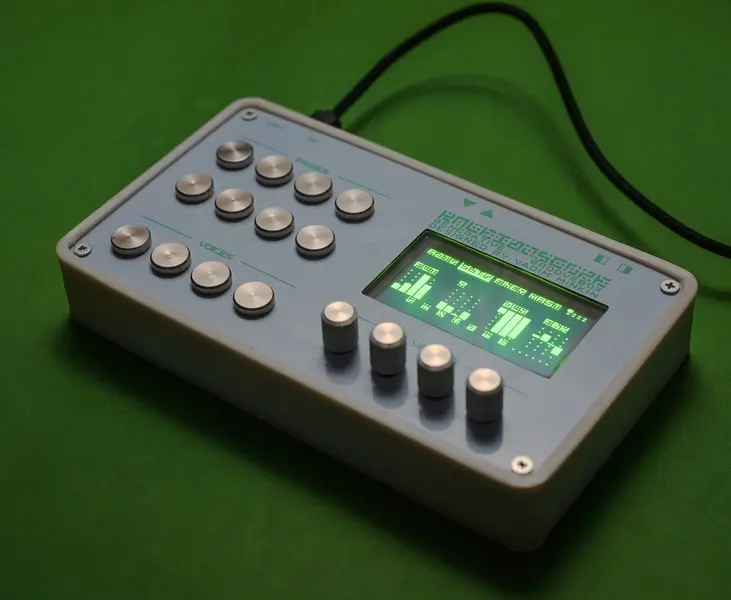
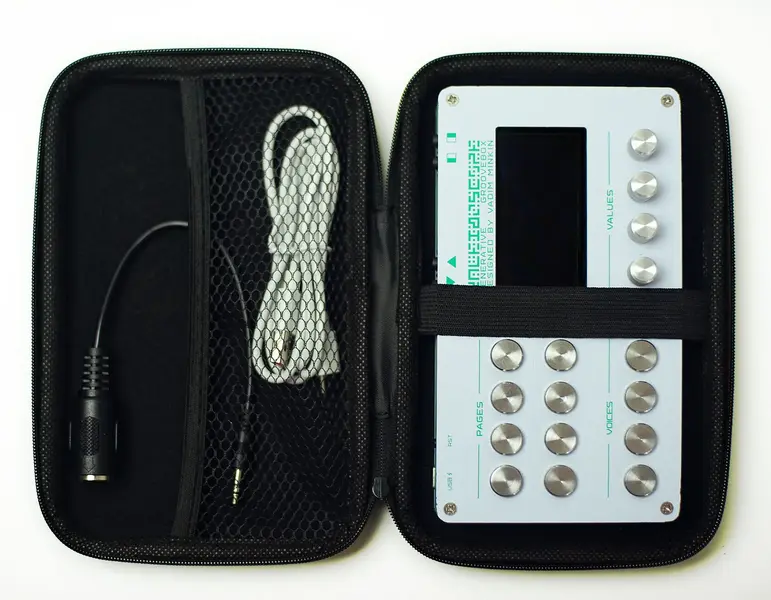
The front panel is minimal - an OLED display, 8 touch sensors for page selection, 4 for track selection, and 4 encoders with built-in buttons. The display always shows the current value of parameters with all modulations applied, so you see exactly what's happening in real time. It also displays thumbnails of all 28 modulators at once (those 8 envelopes plus velocity, aftertouch, keytrack, modwheel, and pitch bend for each track).
The page-based parameter organization takes a moment to learn, but it's faster than endless menu diving once you get it. Touch a group sensor, then touch a page sensor, and you're there - any of 32 pages in two touches. Parameters are grouped logically: waveform control, filtering, frequency, volume envelope, modulation envelope, external modulators, and configuration.
Sound Design Possibilities
The oscillator section generates asymmetrical triangles and pulses simultaneously, with the triangle feeding a wavefolder that can work as either a folder or hard sync. Three parameters - Middle (waveform symmetry), Fold (amount and mode), and Mix (blending with the original) - give you a huge range of timbres from smooth to harsh.
The resonant filter can operate as low-pass or high-pass and is tuned to MIDI note frequencies, making it easy to create harmonic emphasis at specific intervals. After the filter comes an overdrive that changes its character rather than just gain - from subtle saturation to aggressive fuzz.
The comb filter is particularly interesting. Set its delay to match your fundamental and you get resonant overtones. Detune it and you create complex spectral transformations. Use short delays for timbral effects or longer ones for echo. With the internal saturation module, you can even get self-oscillations that depend on the feedback coefficient. It's a key part of the physical modelling possibilities here.
Cross-Modulation and FM
Each track has an FM input that can receive audio from any combination of the other tracks. The routing uses a 4-bit parameter, so track 1 could be modulated by tracks 2 and 4, while track 3 gets FM from all four tracks. The FM volume control is bidirectional, allowing both addition and subtraction of the modulating signal.
The parametric cross-modulation goes even deeper. Each track's volume envelope can modulate two destinations, and each modulation envelope can modulate two more. Every modulation has an 'alias' parameter that lets you adjust the base value without leaving the modulation page. You're not hunting through menus to tweak the filter cutoff while setting up modulation depth - it's right there.
Polyphony and MIDI
The Kaleidoscope can work as a 4-voice polyphonic synth with all tracks on one MIDI channel, or as a multitimbral instrument with each track on its own channel. Each volume envelope and modulation envelope has independent MIDI channel assignments, so you could have two volume envelopes sharing a channel for 2-voice polyphony while their modulation envelopes respond to different channels.
By default the tracks use MIDI channels 5-8, but you can set each track's volume envelope, modulation envelope, and parameter control to different channels. There's even a mode where a modulation envelope auto-triggers with a specific volume envelope, useful for polyphonic setups.
Outputs and Routing
You get 4 mono outputs via two stereo TRS jacks. Each output can carry any combination of the four tracks - all tracks mixed, individual tracks isolated for external processing, or creative combinations. The routing parameter uses binary notation (another 4-bit value) so you can quickly set up splits and layers.
Preset Management
There are 128 preset slots, each storing a complete track configuration. You can save and load presets directly on the device, or export and import them via USB as binary files. The device mounts as a flash drive when you hold encoder 1 and press reset, making it easy to back up your sounds or share them with other Kaleidoscope users.
Build and Power
The Kaleidoscope is compact and lightweight, designed to work anywhere. It's USB-C powered, so you can run it from a power bank for truly portable sound design. The package includes a MIDI TRS Type-A adapter, USB cable, and carrying case.
The developer, Vadim Minkin, built this instrument to combine the compact design and control simplicity of modern multitimbral synths with the flexibility of modular synthesis. It's a device for sound exploration rather than instant gratification - the kind of instrument where you discover new possibilities every time you sit down with it.
Who It's For
The Kaleidoscope rewards curiosity. If you want classic sounds and immediate results, there are easier options. But if you enjoy patching, experimenting with generative patterns, and discovering unexpected sonic territories, this little box has remarkable depth.
It's particularly suited for electronic musicians working with modular systems (the generative approach translates well to Eurorack mindsets), ambient and experimental producers who value evolving textures, and anyone who thinks synthesizers should be instruments for exploration rather than preset players.
At €600, it's not an impulse purchase, but you're getting a unique instrument with capabilities you won't find elsewhere. The deep cross-track modulation routing and generative sequencer design set it apart from both the groovebox competition and traditional polyphonic synths.
The Kaleidoscope is available directly from Vadjuse with 1-2 week production time if not in stock. Each unit ships with a MIDI adapter, USB cable, and carrying case. A detailed 61-page manual is available digitally - and you'll want to read it, as this instrument rewards understanding its architecture.
More News


Notes