Burg: A Castle Full of Dirty, Patchable Sound
Some instruments feel designed. Others feel like they grew out of a workbench, one circuit at a time, until they turned into something you could play. The Burg, made by Liminal Sound Devices in Munich, is firmly in the second camp. It's a semi-modular analog synthesizer and multi-effects box, and from the moment you look at its busy front panel, it tells you exactly what kind of sounds it wants to make: dirty ones.
What It Is
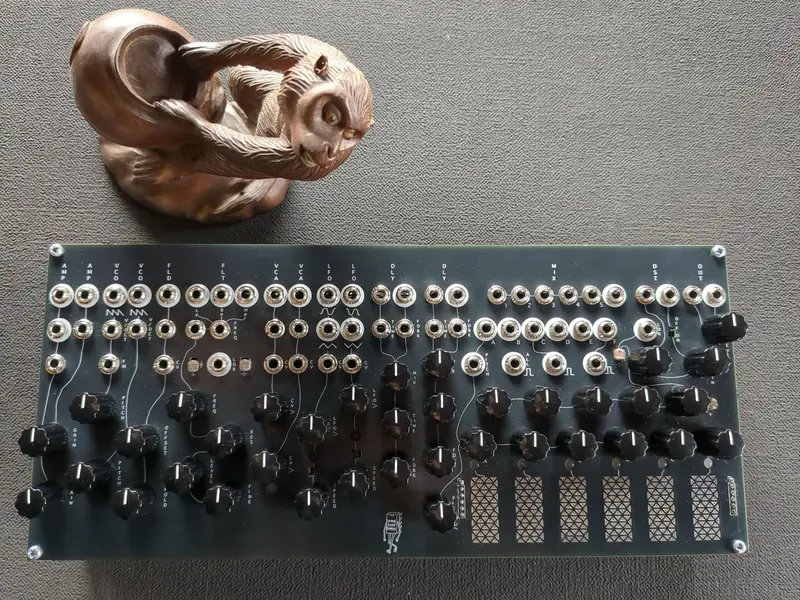
The name comes from a castle in Munich where the device was developed, and there's something fitting about that. The Burg is a small fortress of analog circuitry - 18 individual modules packed into one box, with 55 patching points to connect them. There are 26 inputs, 29 outputs, and 38 knobs in total, which gives you an idea of how much is going on here.
The module list reads like a tour through the classic building blocks of sound design. Two sawtooth oscillators with V/oct and FM inputs. A pingable WASP filter with separate lowpass, highpass, and bandpass outputs. A CV-controllable wavefolder that can also work as a VCA or a lowpass gate. Two more VCAs, an envelope generator, two LFOs, and a five-channel mixer to bring it all together. On the effects side there are two delay units - one built around the glitchy PT2300 chip, the other with PT2399 behaviour - plus a distortion stage with swappable clipping diodes and a pair of high-impedance overdrive amplifiers.
The whole point, according to the maker, was to take these familiar pieces and make them as interchangeable as possible. So the Burg isn't just a synth voice. It's also an instrument processor and an effects unit, depending on how you patch it.
Played by Touch and Light
What makes the Burg stand out from a typical desktop semi-modular is how you actually play it. Instead of a keyboard, there are six touch plates built into the panel, each putting out 0 to 5 volts, each with its own pitch knob. You play them with your fingers, and the feel is closer to a strange little instrument than a synth with a sequencer bolted on.
Then there are the two light sensors. They're Arduino-powered and exchangeable, and they respond to light sources or even motors - so you can modulate the sound by waving your hand over the panel, shining a light at it, or rigging up something that moves. It's an open invitation to experiment, and it pushes the Burg towards performance rather than careful programming. If you'd rather keep things conventional, there are 1V/oct inputs for standard keyboard control and gate outputs to tie it into the rest of your setup.
The Sound
Liminal Sound Devices are honest about where the Burg sits tonally: it leans dirty and noisy. The pingable WASP filter, the two crunchy delays, the distortion, and the overdrive amps all add grit, and stacking them up gets messy in the best way. This is a box for harmonic drones, broken melodies, glitchy textures, and the kind of outer-space noise that doesn't really belong to any genre.
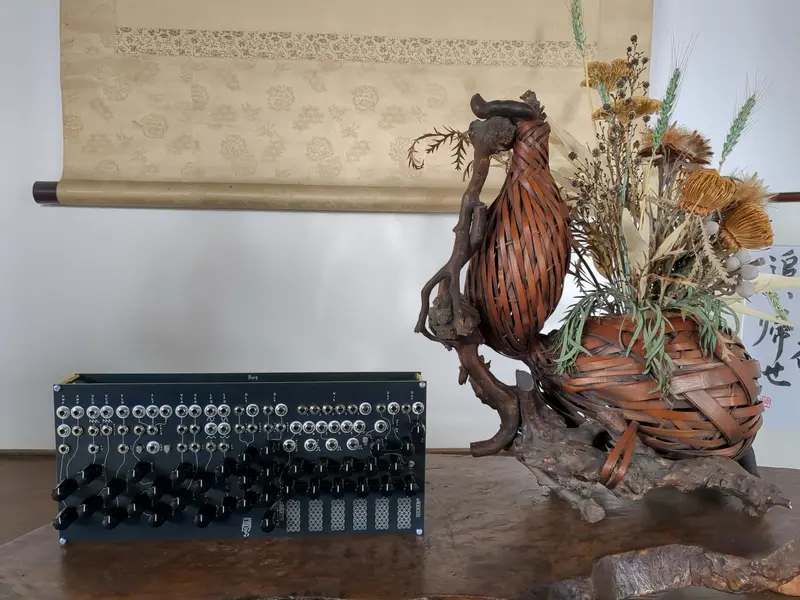
It's not the instrument you reach for when you want a clean pad or a polite bassline. It's the one you patch up when you want something to misbehave a little, and then push it further with the touch plates and light sensors until it surprises you.
Built to Be Opened
There's a deeper layer to the Burg that I find genuinely appealing. The backplate has circuit-bending points, so you can get inside the sound at the component level - changing oscillator frequency ranges, swapping LFO capacitors, trying different distortion diodes, or modifying the VCA transistors. Everything uses through-hole parts, which means components are easy to reach and easy to replace.
That design choice says a lot about the philosophy behind the device. It came out of a lot of time spent in the workshop, learning how electronic circuits actually work, and it's clearly meant to keep that spirit going for whoever owns it. The Burg isn't sold as a sealed black box. It's sold as something you can take apart, understand, and change.
It comes either fully assembled or as a DIY kit, and it's made in small batches on demand rather than mass-produced. The barrel jack accepts 9V to 18V, and the backplate can even supply power to eurorack modules, so the Burg can sit at the centre of a small modular setup rather than off to the side.
A Castle Worth Visiting
What I like most about the Burg is that it doesn't pretend to be tidy. It's a hand-built instrument with a clear personality - a bit chaotic, a bit lo-fi, and very open-ended. The touch plates and light sensors make it physical and playful, the effects section makes it loud and strange, and the bending points make it yours in a way most gear never allows.
If your taste runs towards noise, texture, and happy accidents, and you like the idea of an instrument you can reach inside, the Burg is well worth a closer look. It's a small castle of sound, and the door is deliberately left open.
More News

Notes
Stylophone DS-2: A Drone Box That Fits in a Eurorack