Gotharman Zaturn Zero: A Modular System Folded Into a Box
Gotharman's instruments have always sat in their own corner of the synth world. They're built by one person in Denmark, they don't look like anything else, and they reward patience. The Zaturn Zero is the latest of them, and it's a rebuild of the earlier Zaturn into something tougher, brighter, and slightly more inviting. I've been reading and watching everything I can find about it, and the more I look, the more I want to write down what makes it tick.
A Modular Without Cables
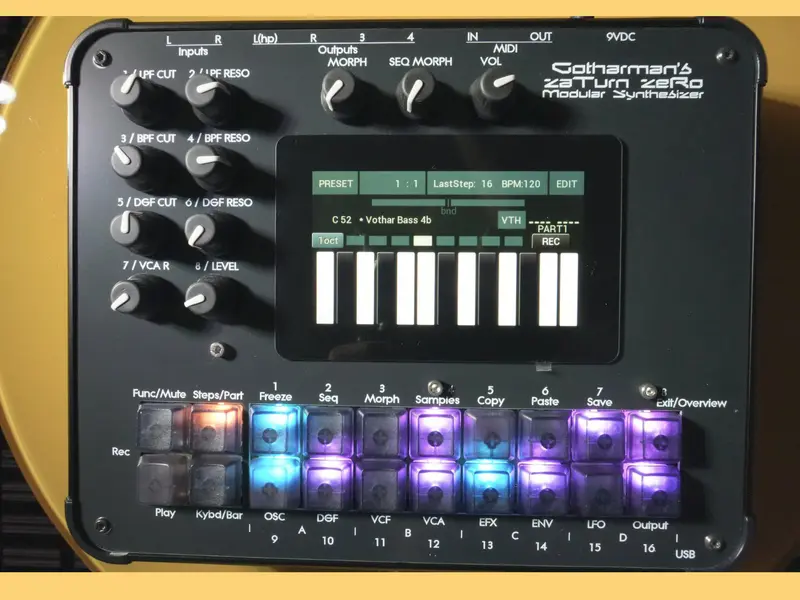
The Zaturn Zero is a hybrid modular synthesizer that fits the modular part inside the screen. You don't patch with cables. Instead, you connect up to 76 different modules through the touchscreen, and the front panel gives you direct control over whichever module you've focused on. That's the trick the whole instrument is built around - the depth lives behind the screen, but the gestures live under your hands.
Internally it's organised into four equal groups: A, B, C, and D. Each group has the same set of building blocks: two main oscillators with morphing waveforms (sine to triangle to sawtooth to pulse to "feedwave"), a second sine-based oscillator, two effects processors, two VCAs with sixteen different envelope shapes, four LFOs, two envelopes with loop modes, sample-and-hold generators, and a ring modulator that can also crossfade or run logic. The group structure is what lets the Zaturn Zero be eight-voice polyphonic and sixteen-part multitimbral at the same time, depending on how you route things.
The Filter Question
When you order one, you choose your filter. There's a digital multimode filter with 28 types built in, including vowel and tube models, and that's already plenty. But the more interesting choice is the analog board, and there are six of them. You can pick the original Zaturn's dual self-resonating 12 dB filters, the 24 dB Spaze filter from PolySpaze, the discrete and slightly unstable Vothar 8 character, the SSI2140-based Multi Filter with selectable slopes, one of the VCF5/7/8 discrete variants, or a classic ladder with overdrive.
That kind of choice at purchase time is rare. Most synths give you one filter and ask you to live with it. The Zaturn Zero treats the filter as part of your identity with the instrument, which fits the way Gotharman's machines have always worked - they assume you care enough to make the decision yourself.
RGB Buttons That Play Notes
One of the more practical changes from the original Zaturn is the front panel itself. The chassis moved from steel to aluminium, and the push buttons are new: higher quality, with RGB backlights, and crucially they can act as a keyboard. You can play the Zaturn Zero from the device itself, without having to plug a controller in. It's not a velocity-sensitive grid like a Push or a Linnstrument, but for sketching ideas, auditioning sounds, or step-entering melodies, it's a real change in how the box feels day to day.
Morphing the Whole Modular
The headline feature, for me, is morphing. Every preset on the Zaturn Zero holds two versions of itself, and a single knob crossfades between them. Because the engine underneath is a modular system, that one knob is moving every parameter in the patch at once - oscillator settings, filter type behaviour, modulation routings, effects. It's the kind of gesture that turns a static sound into a small piece of music on its own.
Gotharman puts it plainly: with one knob you can morph all the settings of a complete modular system. That sentence sounds like marketing until you watch it happen, and then it makes the rest of the spec sheet feel almost secondary.
Sequencer and Memory
The sequencer has eight note tracks and sixteen controller tracks for automation, with a position subtrack that lets steps move around in time rather than sit on a fixed grid. Storage is generous for a boutique instrument: 1024 presets, 1024 songs, 64 favourite sounds, and up to 8192 sample slots. The favourites system, borrowed from SpazeDrum, lets you flag specific sounds for fast recall while you're playing, which is the right shape for a groovebox workflow.
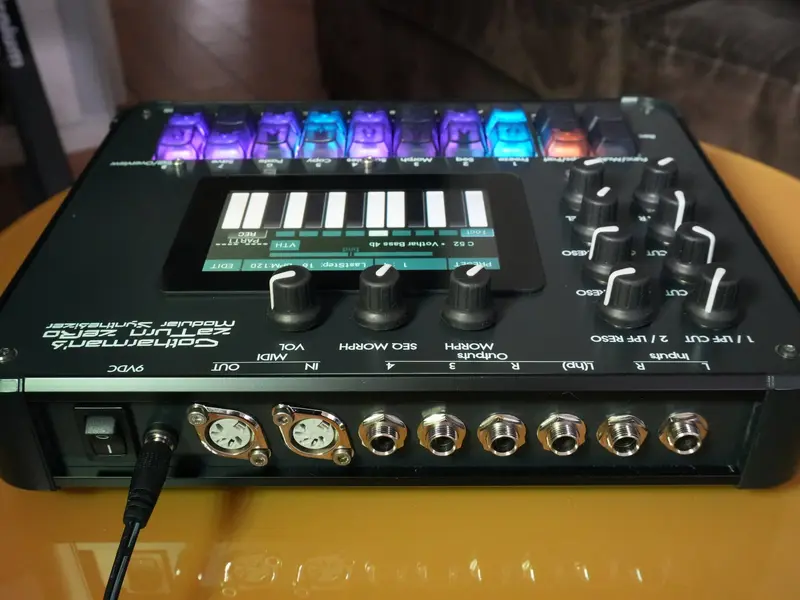
On the back you get four audio outputs, a stereo line input on 6.3 mm jacks, 5-pin MIDI in and out, and a power switch. CV in and out are available through Gotharman's AnaX USB add-on, which keeps the main panel uncluttered while still letting the Zaturn Zero talk to Eurorack.
Who It's For
The Zaturn Zero isn't trying to be friendly in the way a Move or an OP-1 is friendly. It's a deep instrument that expects you to dig in. But the redesign has clearly tried to soften the steepest parts of that climb: the RGB keyboard, the aluminium body, the extra outputs, and the fact that one knob can do something dramatic without you needing to understand the patch underneath.
If you already love Gotharman's instruments, the Zaturn Zero is exactly the upgrade you'd hope for - same philosophy, better build, more ways in. If you're new to the brand and you want a modular system that fits on a desk, runs without cables, and can sequence and sample its own sounds, this is one of the more interesting boxes you can buy right now. It's still hand-built in Denmark, still made in small numbers, and still very much its own thing. That's the part I keep coming back to.
More News
Notes