Neutral Labs Luna: Falling for a Synth That Shouldn't Exist
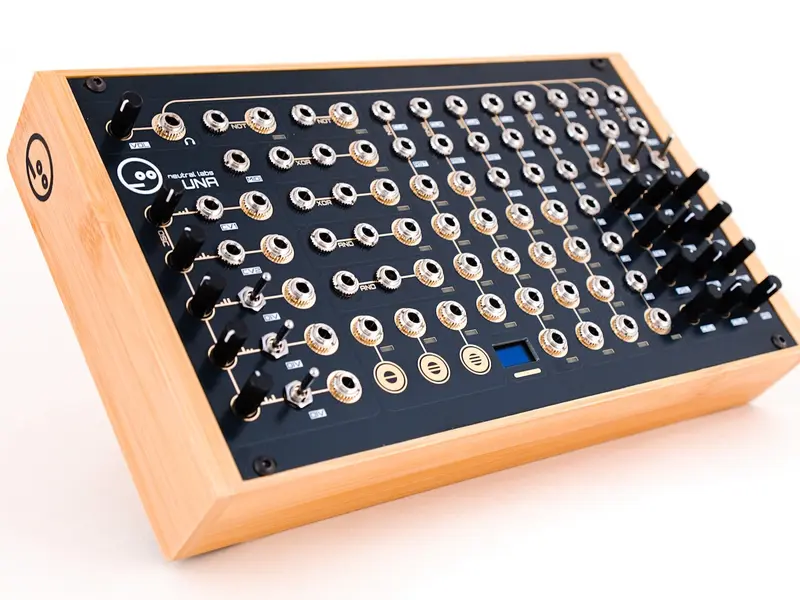
There's something appealing about instruments that don't pretend to be polite, and the Neutral Labs Luna is exactly that kind of machine. It calls itself "the first serious Lunetta synthesizer," and that promise alone is enough to pull you in. This is a synth built around exposed CMOS logic - the same cheap digital chips that powered the homemade noise boxes of the 1970s DIY scene. Luna takes that scrappy idea and gives it a proper home, either as a 42 HP Eurorack module or a semi-modular desktop unit.
What a Lunetta Actually Is
For anyone who hasn't gone down this particular rabbit hole, a Lunetta is named after the artist Stanley Lunetta, who built sound machines out of logic gates instead of traditional oscillators. Neutral Labs clearly had fun with that heritage - the name "Luna" sits right inside "Lunetta." The chips were never meant to make music. They were meant to count, switch and compare - and when you push square waves through them, they produce these jittery, glitchy, oddly rhythmic tones that no "normal" synth would ever make.
That is the heart of Luna. It doesn't try to sound smooth or warm. It embraces the math, the errors and the chaos, then hands you the tools to shape it all into something you can actually play.
Five Oscillators and a Brain You Can Rewire
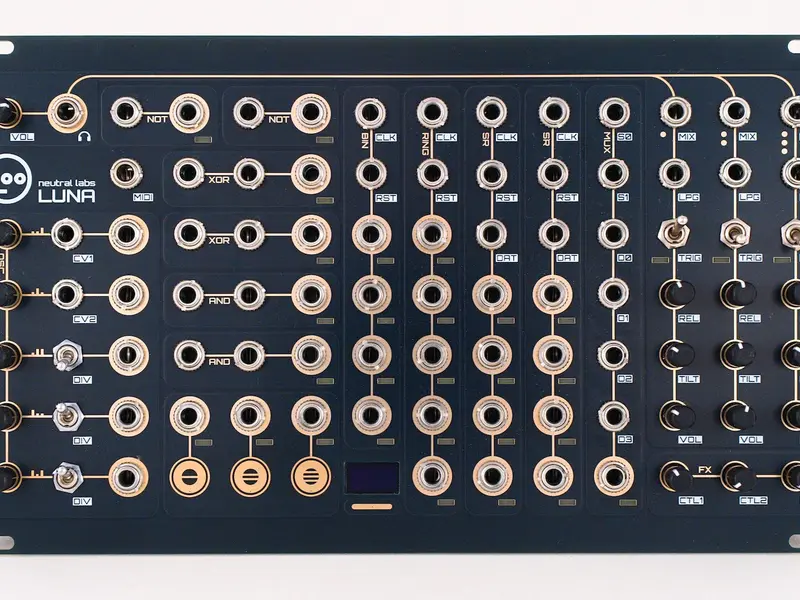
The synthesis core starts with five oscillators feeding a chaotic digital processor. From there things get wild: there are XOR, NOT and AND logic gates, plus a ring counter, a binary counter, shift registers and a multiplexer. Two of the oscillators respond to CV, so you can pull some of this chaos under control if you want to.
The really striking part is that the CMOS inputs and outputs sit right there on the front panel. You're not just patching effects or modulation - you're rewiring the brain of the instrument itself. Patch one logic output into another input and the whole personality of the sound shifts. It looks less like programming a synth and more like performing tiny experiments and seeing what survives.
Turning Chaos Into Music
All that digital madness would just be noise without a way to tame it, and Luna handles that with three analog low-pass gates. Each one has decay, gain and a tilt EQ, so you can soften the harsh edges and turn raw logic into something closer to percussion or pad. Neutral Labs sums up the whole philosophy nicely: "Rhythm is Timbre. Timbre is Rhythm." Change the speed of an oscillator and you're not just retuning it, you're reshaping the groove.
There are also three touchpads that generate logic signals directly from your fingers, which makes the thing feel surprisingly hands-on and immediate.
Effects, Sequencing and the Practical Bits
Luna isn't only about raw grit. It packs 13 audio effects - drive, delay, reverb, bitcrusher, phaser, chorus, comb filter and six filters - that you can freely assign to two effect slots. So you can smear your logic into ambient wash one minute and grind it into industrial texture the next.
On the practical side, there are two sequencers of up to 64 steps each, MIDI control over the oscillators, gates and logic outputs through a TRS connector, and clock sync to keep it in line with the rest of a setup. The desktop version runs from simple 5V USB power and ships with patch cables, which makes it easy to just plug in and start poking around.
Why It Stays on the Mind
The pull of Luna is that it doesn't behave. Most modern gear chases stability and predictability, and here's a synth that turns mathematical mistakes into its main feature. It rewards curiosity and a bit of bravery, and it punishes the urge to control everything. For anyone who likes their sounds broken, percussive and a little dangerous, this is a machine worth losing an afternoon to - probably more than one.
More News


Notes
Stylophone DS-2: A Drone Box That Fits in a Eurorack