Stylophone DS-2: A Drone Box That Fits in a Eurorack
I have a soft spot for the Stylophone. Most people meet it as a toy - a little metal slab with a stylus you drag across a printed keyboard, the thing that made the buzz on David Bowie's "Space Oddity". So when I saw the name on a fully analog drone synthesizer with patch points and a Eurorack bus connector, I had to look twice. The DS-2 keeps the Stylophone badge and throws away almost everything else. It's the first product in a new "Compact Portable Modular" range, and it's clearly aimed at people who already own cables.
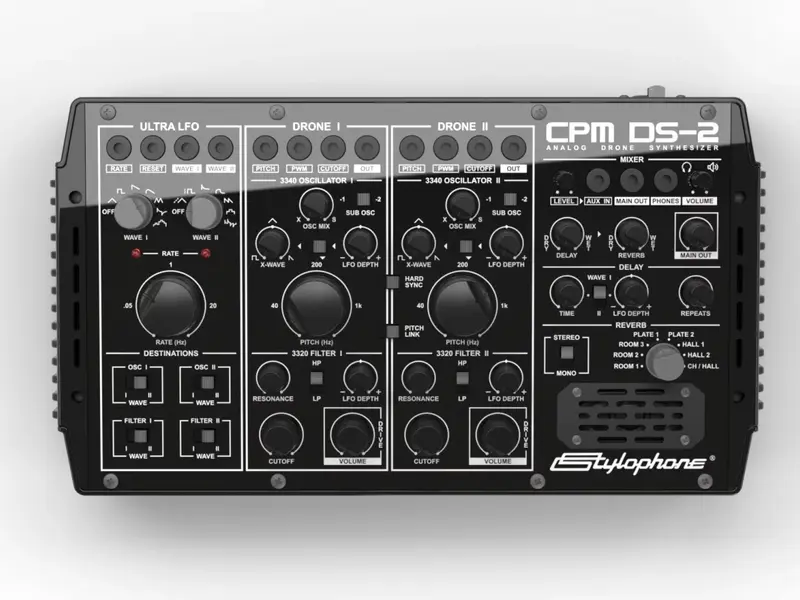
Two Voices, Built to Hum
The DS-2 is a drone machine first. Inside it there are two 3340-based oscillators, each with its own sub-oscillator running an octave or two below, and a 3320-based filter that does both low-pass and high-pass with the usual cutoff and resonance. Those chip numbers will mean something to people who chase classic analog sound - they're the same lineage that sits behind a lot of well-loved synths from the early eighties. Here they're set up to drift, beat against each other, and hold long evolving tones rather than play tidy melodies.
You can link the two voices or hard-sync them, which is where the harmonics get interesting. With a bit of detune and the filter doing its thing, one knob nudge can turn a calm pad into something that snarls. There's no keyboard and no real expectation that you'll play notes in the traditional sense. You set a sound in motion and then you ride it.
The Ultra LFO
The part I keep coming back to is the LFO. Stylophone calls it the "ultra" LFO, and it carries 14 analog waveforms with two dedicated outputs that can each send a different shape at the same time. There's a seven-switch modulation matrix on the panel and five depth attenuverters, so you can dial motion in and out without touching a single cable if you want to.
That matters because it sets the whole tone of the instrument. The DS-2 isn't about presets or menus - it's about turning things until the drone starts to move on its own. The LFO is the engine for that, and having two independent outputs means the two voices can wander on separate paths instead of locking together.
Delay and Reverb On Board
A drone box lives or dies on its effects, and the DS-2 doesn't leave you hanging. There's a PT2399-based delay with its own modulation, which gives you that slightly unstable, vintage echo that suits this kind of sound. Next to it sits a reverb built on the AL3201 chip, with eight algorithms - a few rooms, a couple of plates, a couple of halls, and a chamber - that you can run in mono or stereo.
Having both effects built in means a single DS-2 can sound like a finished piece on its own. You don't have to route it out to a pedalboard to make it feel deep. That said, it plays nicely with outboard gear too, thanks to a stereo output pair and an aux input for pulling other sounds through the box.
Twelve Patch Points and a Eurorack Trick
The modular side is where the DS-2 earns the "M" in its CPM name. There are twelve 3.5mm patch points: pitch, PWM and cutoff inputs for the two drone channels, plus rate and reset for the LFO, and the two LFO outputs. That's enough to fold the DS-2 into a CV-heavy setup and let an external sequencer or another module drive it.
Then there's the part that made me grin. The whole unit lifts out of its case and mounts as a 42HP Eurorack module, powered straight from the bus connector. So it works three ways: as a standalone tabletop synth, as the heart of a small patch, or as a permanent module in a bigger rack. Not many instruments let you start casual and commit later without buying anything new.
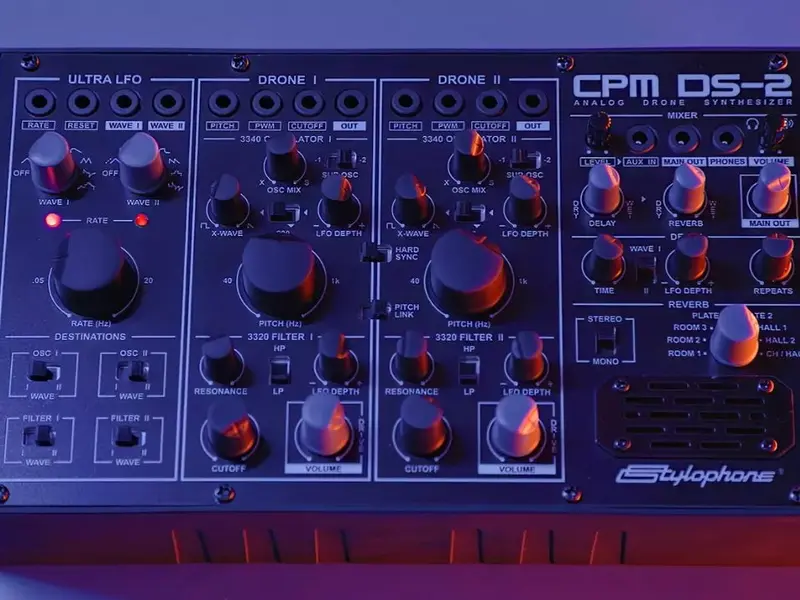
It Runs on Batteries
For all the modular talk, the DS-2 hasn't forgotten where it came from. It takes six AA batteries and has its own built-in speaker, so you can pick it up, walk to a park bench, and make drones without a wall socket or an amp anywhere in sight. There's a headphone jack too, and mains power when you want it.
That combination is the thing I find genuinely charming. A patchable analog synth with a Eurorack bus connector that you can also just grab and carry outside on a set of batteries - those two ideas don't usually live in the same box. It's the most Stylophone thing about the DS-2, even though nothing else about it looks like the old stylus toy.
Where It Lands
The DS-2 is a strange and likeable instrument. It's not a melody machine and it won't replace a proper poly synth, but that was never the point. It's a focused drone and texture box that happens to speak fluent CV, fits into a rack when you're ready, and still works on batteries when you're not. For anyone who likes long evolving sounds and hands-on tweaking - and who maybe grew up with a Stylophone and is curious where the name went - this is an easy one to fall for. The badge is the same. Everything behind it has grown up.