Mutable Instruments Anushri: Where Analog Meets Algorithmic Grooves
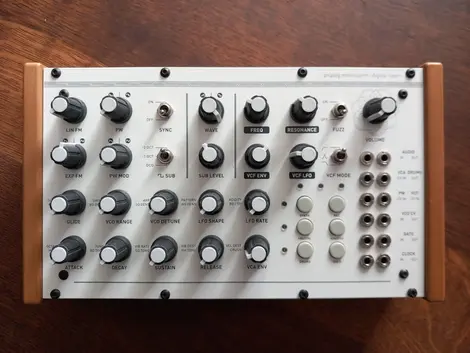
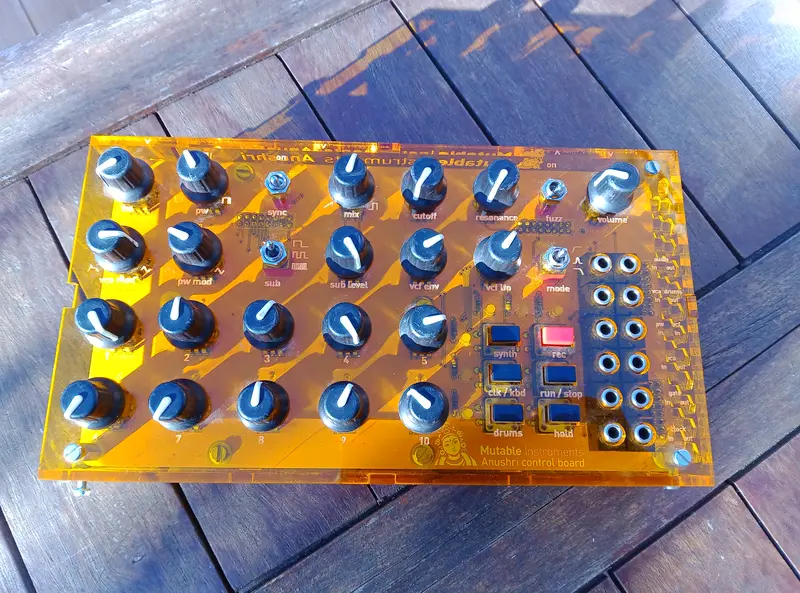
Continuing our exploration into the legacy of Mutable Instruments' DIY era, we arrive at the Anushri - a delightfully quirky monosynth that brought together analog synthesis, digital drums, and creative sequencing in one compact, orange-tinted package. Released in October 2012, the Anushri represented something of a departure from the complex Ambika that came the same year, offering instead a more immediate and playful approach to electronic music making.
The SH-101 Spirit
The Anushri wears its influences proudly on its sleeve. The audio generation chain follows the same formula that made the Roland SH-101 and MC-202 so beloved: a VCO producing sawtooth and pulse-width waveforms, coupled with a sub-oscillator, feeding into a filter and VCA. But Olivier Gillet, the mind behind Mutable Instruments, added some distinctive touches that set the Anushri apart.
The multimode voltage-controlled filter operates at 12dB per octave - a refreshing change from the rounder 24dB Moog-style filters that dominated the DIY synth world. This gave the Anushri a more open, aggressive character, especially when pushed into self-oscillation. A post-filter fuzz circuit added even more bite when needed, bringing a dose of nasty distortion that could transform delicate leads into screaming noise.
The Digital Twist
What made the Anushri more than just another SH-101 clone was its digital auxiliary oscillator - a DCO that could serve as an FM modulator, a hard-sync master for the main VCO, or simply a detuned second voice. This hybrid approach allowed for tonal possibilities that went well beyond what a pure analog monosynth could achieve, from metallic FM timbres to thick detuned bass sounds.
The modulation system included a versatile LFO with eight waveforms, including traditional shapes alongside more unusual options like Bernoulli random and piecewise linear random processes. Three envelope generators - an AD for pitch and pulse width modulation, plus two ADSRs for filter and amplitude - provided plenty of control over sound evolution.
Drums That Think for Themselves
Perhaps the most characterful feature of the Anushri was its built-in drum synthesizer. Rather than implementing a traditional x0x-style step sequencer, Gillet designed something far more playful: an algorithmic pattern generator controlled entirely by knobs.
The drum section produced lo-fi, 8-bit sounds for bass drum, snare, and hi-hat. The bass drum and snare used pitch and amplitude-modulated digital oscillators combined with noise, whilst the hi-hat employed variable-speed sample playback. None of it sounded particularly realistic - but that was never the point.
Two knobs morphed through a map of drum patterns organised by similarity, whilst three additional knobs controlled the density of hits for each drum voice. Twist a knob and the pattern would gradually fill in or thin out, creating natural-sounding fills and variations. It was less like programming drums and more like sculpting them.
Sequencer and Arpeggiator
The Anushri's 128-step sequencer took inspiration from the SH-101 and JX-3P, offering real-time note recording with slides and accents. The arpeggiator included multiple modes and six rhythmic patterns, with an "acidity" parameter that randomly added slides and accents - perfect for generating those classic acid bass lines.
Clock synchronisation options included internal tempo control from 40 to 240 BPM, with external clock input accepting 24, 8, or 4 pulses per quarter note. This made it easy to integrate the Anushri with modular systems or other hardware.
Open to the Modular World
Twelve 3.5mm jacks on the front panel connected the Anushri to the wider world of modular synthesis. CV inputs and outputs for VCO, VCF, pulse width, and VCA allowed external control or the use of Anushri's signals to modulate other gear. Gate and clock I/O completed the connectivity picture, whilst standard MIDI provided traditional keyboard and DAW integration.
The internal signals operated at 5V peak-to-peak - designed for low-power battery operation rather than the hot Eurorack standard - but this only meant attenuators or amplifiers might be needed when connecting to some modular systems.
The DIY Experience
Like other Mutable Instruments projects, the Anushri was sold as a kit. The through-hole PCB design made it more accessible than the surface-mount builds required by some of the company's other products, though it still represented a substantial project with over 400 solder points and 20 ICs to socket.
The original kit cost less than 200 euros and included everything needed except the case. That distinctive orange plexiglass enclosure became iconic, though the open-source design files meant builders could create custom cases in any colour they fancied.
Comprehensive documentation and the supportive Mutable Instruments community helped many first-time DIY builders successfully complete their Anushri. For many, it served as an introduction to both kit building and synthesis concepts - a gateway instrument in more ways than one.
Legacy
The Anushri is now discontinued, though the open-source firmware and schematics remain available for those who want to build their own. Finding original kits has become difficult, but projects like the Skookum Anookum from Modular Addict keep the design alive with new panels and continued production.
As Mutable Instruments shifted focus entirely to Eurorack modules following the Anushri's release, this orange-clad monosynth marked the end of an era. It captured something special about the DIY period - the sense that synthesizers could be playful, experimental, and accessible all at once. The algorithmic drum machine and knob-per-function interface encouraged exploration over precision, making music creation feel more like play than work.
For those who built or acquired an Anushri, it remains a characterful instrument with a sound and workflow quite unlike anything else - a fitting tribute to Mutable Instruments' commitment to innovative design during their formative years.
More News
Notes