DecadeBridge Albers: Drone Synthesis With a Human Touch
Drone synthesis has a special place in the world of small, handmade instruments. When you build something that's meant to sit and breathe and evolve slowly, you're making a conscious choice about what kind of music you want to make - and what kind of experience you want to have. DecadeBridge's Albers feels very much like that kind of deliberate decision.
Four Oscillators, One Direction
The Albers is built around four oscillators that all mix together before heading to a low-pass filter and then out. Each one is identical in design: a pitch knob, a volume knob, a three-way range switch, and a handful of jacks for CV input. The range switch lets each oscillator operate in three different frequency zones - a useful touch if you want to spread voices across the harmonic spectrum without constantly fighting the pitch controls.
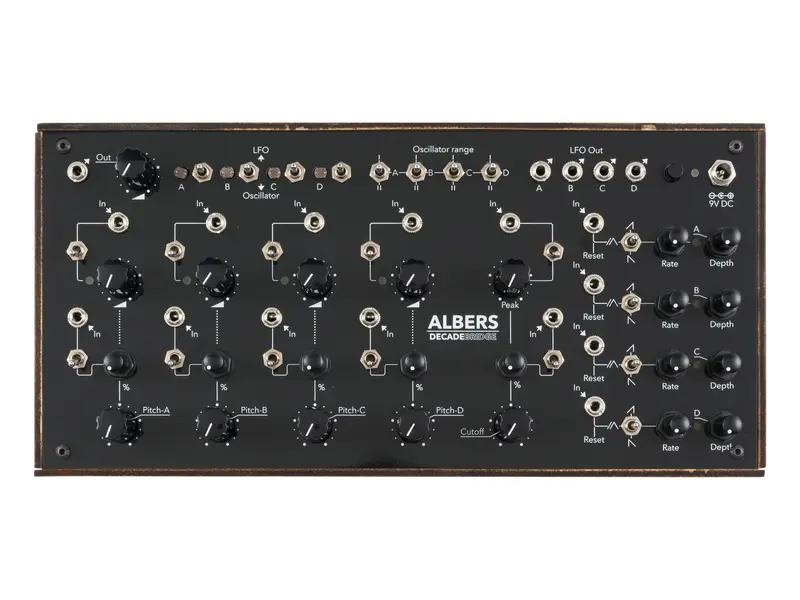
Each oscillator has its own VCA, which you can switch between free-running and externally controlled. The pitch input is flexible enough to accept CV, audio signals from instruments, or even contact mics - and if the voltage drops below zero, the oscillator mutes itself. That's a small but surprisingly useful behaviour for creating rhythmic gating effects without additional gear.
Light as a Modulator
The four light-dependent resistors (LDRs) are one of the more distinctive features of the Albers. Each LDR can be routed in three ways: disconnected (centre position), controlling LFO rate, or controlling oscillator pitch. The idea of using a torch or a moving light source to modulate sound is one of those ideas that sounds gimmicky until you actually do it - at which point it becomes oddly compelling.
The LDRs aren't precise or predictable, but that's sort of the point. They introduce a physical, environmental quality to the sound that's hard to replicate with a knob.
LFOs With Reset
Each oscillator has a dedicated LFO that's internally wired to modulate its pitch. The three waveforms - ramp up, triangle, and ramp down - cover a useful range of motion shapes. The triangle wave runs at half the speed of the ramp waves, which means you can get some interesting rate relationships going between different oscillators without touching the rate knobs.
The Reset input is worth noting. You can send a trigger or gate signal to snap the LFO back to the start of its waveform. Patch one LFO's output into another's Reset input and you can create rhythmic or polyrhythmic relationships between them. It's a small, clever addition that pushes the Albers beyond simple, static drone territory.
The Filter and Overall Character
The 2-pole low-pass filter ties everything together. It has controls for cutoff and peak (resonance), and both accept CV input through dedicated jacks. When an LFO output is patched externally rather than used internally, it breaks its internal connection to the oscillator pitch - meaning you can route it into the filter's CV inputs for slowly evolving cutoff movement instead.
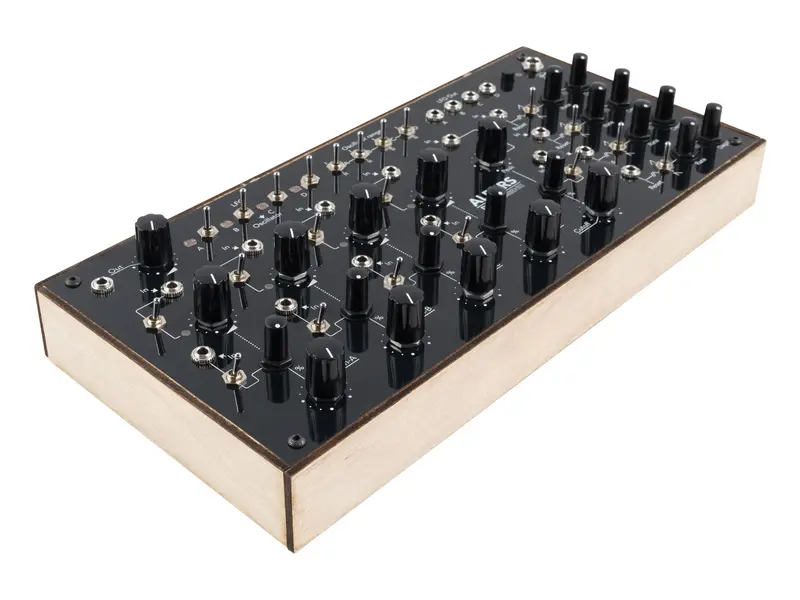
The Albers runs off a 9V battery, which adds to its portable, self-contained character. DecadeBridge doesn't include a wall adaptor to keep costs down, but the synth does accept a 9V DC centre-positive adaptor for longer sessions.
Built in Cheshire
DecadeBridge builds the Albers by hand in Cheshire, England. That context matters - it shapes the kind of instrument this is. It's not designed for mass production or a hundred different use cases. It's a focused instrument with a clear sonic intention: sustained, light-responsive, slowly evolving drone sounds.
For anyone interested in ambient sound design, extended performance, or simply the meditative practice of listening to oscillators breathe together, the Albers offers a genuinely appealing approach to synthesis.
More News
Notes