Dubreq Stylophone S-1: The Pocket Synth That Never Quite Went Away
Few instruments have travelled as light as the Stylophone. It fits in a coat pocket, runs on a handful of batteries, and you play it with a little metal pen instead of a keyboard. For something so small and so cheap, it has had a remarkably long life - nearly sixty years of buzzy, lo-fi charm. The current S-1 from Dubreq is the latest chapter in that story, and it stays surprisingly faithful to where it all began.
A Toy Piano and a Bright Idea
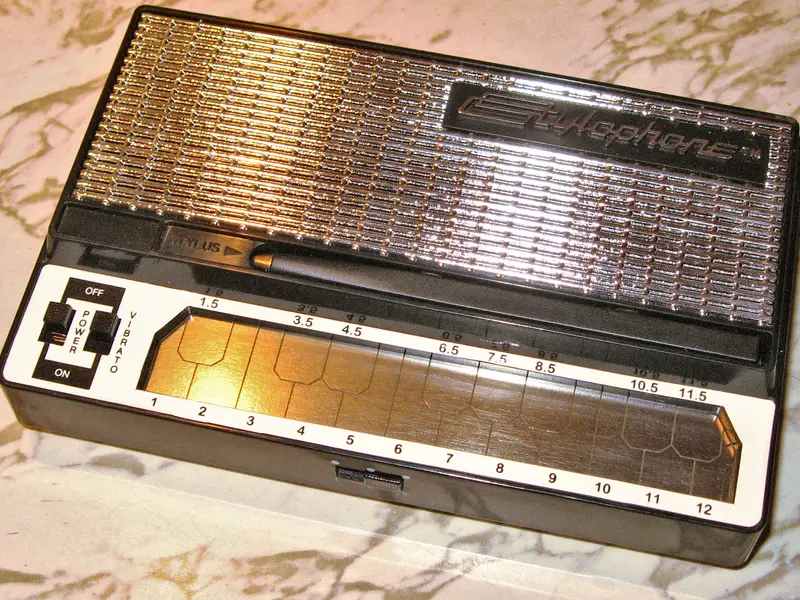
The Stylophone was born by accident in 1967. Brian Jarvis, an engineer at the British company Dubreq, was repairing a toy piano for his niece when he wondered what would happen if he swapped the mechanical parts for electronics. The result was a flat metal keyboard, printed onto a circuit board, that you touched with a stylus to close a circuit and trigger a note. Each key fed a single oscillator through a different resistor, so each contact point produced a different pitch.
Production began in 1968, and the timing was perfect. The Stylophone arrived just as electronic sound was creeping into pop music, but at a price any family could afford. It was marketed as a toy, sold through the kind of adverts that promised hours of fun, and it worked: roughly three million units left the factory during its first run.
From Bedrooms to Hit Records
What the marketing did not predict was how seriously musicians would take it. David Bowie famously used a Stylophone on "Space Oddity" in 1969, giving the little device a permanent place in rock history, and he picked one up again decades later for his 2002 album Heathen. John Lennon was spotted playing one during Beatles rehearsals around the same time.
Then came Kraftwerk, who put the Stylophone front and centre in their 1981 track "Pocket Calculator" - a song quite literally about playing music on tiny handheld gadgets. For an instrument that started life as a children's toy, that was quite a CV. The buzzy, slightly comical tone turned out to be its strength: it sounded like nothing else, and it sounded instantly recognisable.
Gone, Then Back Again
Dubreq stopped making the Stylophone in 1975, and for a while it became a charity-shop curiosity. But nostalgia is a powerful thing. In 2007 the brand returned, with a reissue that closely followed the original design while quietly adding a few modern touches - a volume control, an audio output for plugging into an amp or recorder, and a couple of extra sounds.
That revival opened the door to a whole family of Stylophones. There are beatbox versions, and more ambitious models like the Gen X-1 that pile on filters, an envelope, an LFO and delay. The S-1, though, holds a special place: it is the one that stays closest to the 1968 original, keeping things deliberately simple.
What the S-1 Actually Does
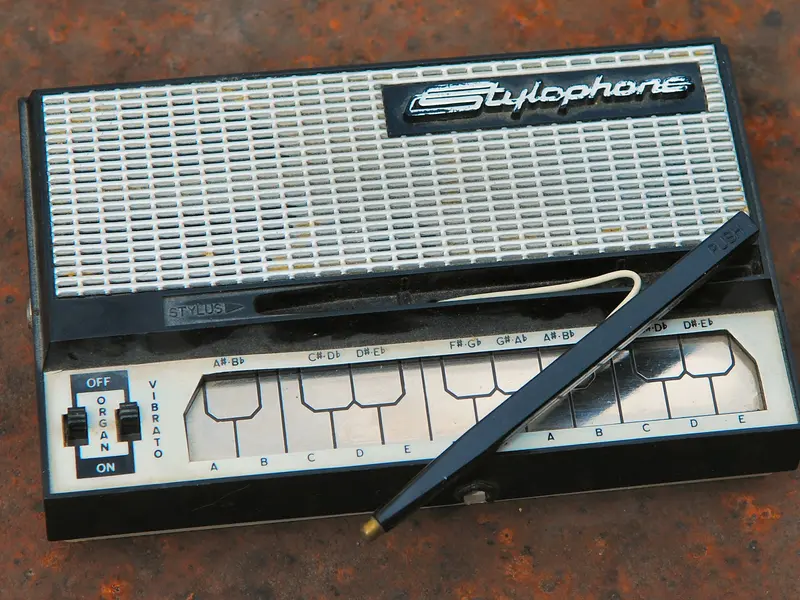
Pick up an S-1 and the layout will be familiar to anyone who has seen the classic. You play by tapping and sliding the stylus across the touch-sensitive metal surface, where each segment plays a different note. There is a built-in speaker with a volume control, plus a headphone jack for quiet practice or for recording cleanly.
The sound side is charmingly basic. A tone switch offers three voices to choose from, and a vibrato switch adds that wobbly, retro warble that defines the Stylophone sound. A tuning control lets you nudge the pitch into line with other instruments. That is more or less the whole instrument - no menus, no presets, nothing to read a manual about. You slide the pen and you make a noise, and most people are grinning within seconds.
Built to Be Carried
If there is one thing the S-1 gets absolutely right, it is portability. The whole instrument runs on three AA batteries, so there is no charging, no cables, and nothing to plug in before you can play. The stylus tucks into the body, the speaker is built in, and the entire thing is small enough to drop into a bag or a large pocket without a second thought.
This is what keeps the Stylophone relevant in an age of powerful pocket synths and phone apps. It does not try to compete on features. Instead it offers something many bigger instruments cannot: you can pull it out on a train, on a sofa, or in a park, make a quick sketch of an idea, and put it away again - all without finding a power socket. For a synth that traces its roots back to a repaired toy piano, being genuinely take-anywhere is a fitting legacy.
A Small Survivor
The Stylophone's appeal has always been hard to pin down. It is too simple to be a serious studio tool, yet serious artists keep reaching for it. It was sold as a toy, yet it has outlasted countless "proper" synthesizers. The S-1 understands exactly why people love it: that buzzy oscillator, that playful stylus, and the freedom to make music wherever you happen to be. Nearly sixty years on, the formula still works - and it still fits in your pocket.
More News
Notes