GLX Balsam: Eight Sliders, Eight Voices, One Very Unusual Synth
There is something refreshing about an instrument that does not try to look like everything else. The GLX Balsam, made by a small boutique studio in Durham, NC, takes the idea of a polyphonic synthesizer and quietly throws the keyboard out the window. What you get instead is eight sliders - one for each voice - that let you pitch bend and articulate notes in real time, more like a steel guitar than a conventional synth.
Eight Sliders, Eight Voices
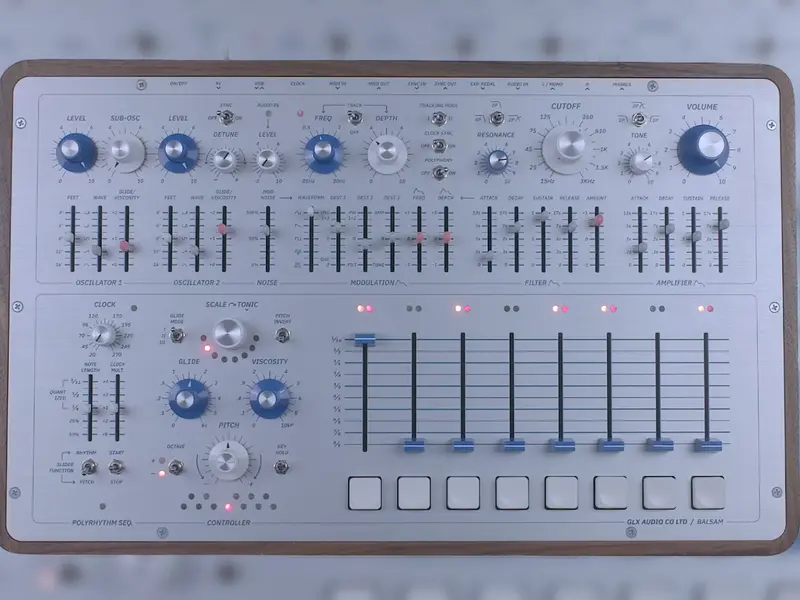
The core idea here is simple but genuinely unusual. Each of the eight voices has its own dedicated slider, and each slider is a pitch bender. You trigger notes with small white buttons next to the sliders, then push the slider to bend the pitch of that individual voice independently. You can have all eight voices sounding at once, each drifting in its own direction.
The inspiration reportedly comes from instruments like the pedal steel guitar, as well as older polysynths such as the Yamaha CS-80, which had per-voice controllers. But the Balsam takes the concept further, building the whole interface around that idea rather than treating it as an add-on.
There is also a "viscosity" parameter that adds slew limiting to the pitch bending - so instead of snapping to a new pitch when you move a slider, the oscillator glides there slowly, like it is wading through something thick. That alone opens up a lot of interesting expressive territory.
The Sound Engine
Under the hood, the Balsam uses a hybrid architecture: virtual-analog oscillators running digitally, paired with a stereo analog state variable filter and an analog VCA. Each voice has dual oscillators with sync, a sub-oscillator, and noise generation. It is a fairly full-featured engine for a boutique instrument.
The filter is a state variable type, which gives you low-pass, high-pass, and band-pass options in a single circuit. Running it in stereo is a nice touch - it keeps the sound wide and interesting without having to add extra processing.
Tuning and Sequencing
One of the more thoughtful details is the tuning system. You can switch between equal temperament and just intonation, and you can upload custom tuning banks through a browser-based interface. For anyone interested in microtonality or non-Western scales, this is a meaningful feature rather than a marketing checkbox.
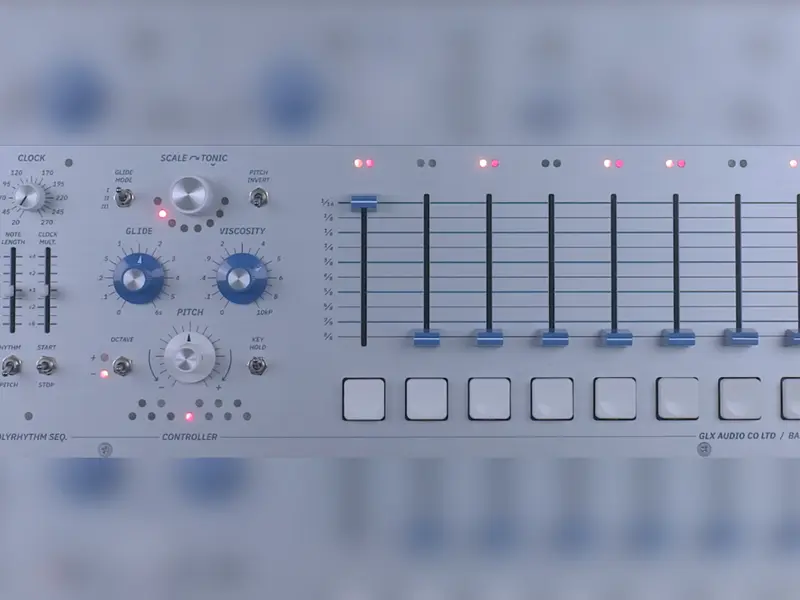
The built-in sequencer is polyrhythmic - each of the eight channels can run at its own subdivision of the clock, with quantized or unquantized operation. Moving the sliders changes the subdivisions in real time, which blurs the line between playing and programming in an interesting way.
There is also MPE output, which means the Balsam can transmit per-voice expression data to other instruments and software, turning it into a rather capable expressive controller on top of its own sound engine.
A Small Studio Making Something Specific
GLX Audio is run by designer and musician Matthew O'Connell out of Durham, North Carolina. The Balsam's enclosure is made from American walnut - reportedly from trees felled by a tornado, which gives it a slightly unlikely backstory. The first presale batch sold out within twelve hours, and the next run is expected in late spring 2026.
It is one of those instruments that seems to attract a very specific type of player - someone who wants to get away from keyboard-centric thinking and explore polyphony in a more physical, less conventional way. Whether the slider interface clicks for you or not, it is hard to argue with the sincerity of the concept. The Balsam feels like it was made by someone who genuinely wanted to play something that did not yet exist.
More News

Notes