GRM Tools Atelier: Sound as Raw Material
There are plugins that help you make music, and then there are tools that change how you think about sound. Atelier, from GRM Tools, belongs firmly in the second category. It comes out of INA GRM - the Institut national de l'audiovisuel's Groupe de Recherches Musicales - which is, in plain terms, the French research institution where Pierre Schaeffer developed musique concrète. So when the developers say they want you to work with sound directly, as raw material, they mean it. That idea has been baked into their DNA for decades.
What It Actually Is
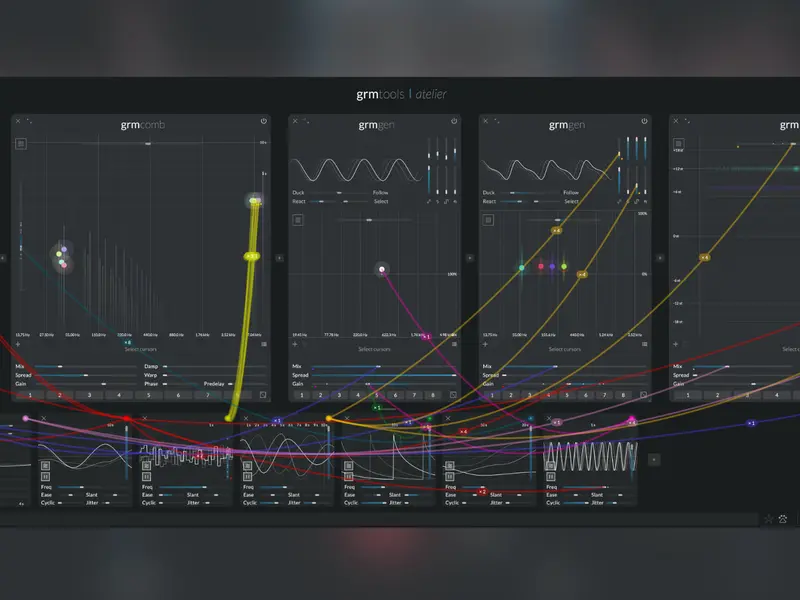
Atelier is a modular environment available as a standalone application and as a plugin (VST3, AUv2, AAX) for macOS and Windows. You build signal chains from two families of modules: Processors and Modulators. Processors either generate or transform sound - Play, Gen, Band, Pitch, Time, Gain, Viz, and Comb. Modulators provide assignable control signals - Agitation, Control, and Peak.
The key word here is "chainable". You connect these freely, in whatever order makes sense to you, and the system doesn't judge your routing choices. The developers are quite intentional about this: "Nothing is a black box; there is no wrong way to use them." That's a surprisingly rare attitude in plugin design, where most tools have a clear intended workflow and quietly resist anything else.
The Polyadic Engine
The modulation system is called the Polyadic Modulation Engine, and it's genuinely different from standard LFOs and envelopes. The idea is that modulations themselves can be layered, stacked, and made to interact - you can build patches that evolve over time in ways that feel almost alive, without it devolving into randomness. Everything is modulatable, and the engine promises to do this without introducing artifacts.
I find this kind of design philosophy refreshing. Rather than offering you a preset patch with slots for "vibrato" and "filter sweep", Atelier asks you to think about how control signals move through your system. It's closer to modular thinking than standard plugin thinking, but contained within a single application rather than spread across a rack.
Discovering Sound, Not Programming It
What I appreciate most about Atelier's philosophy is its insistence on listening over planning. The developers describe it as a platform where you "be guided by what you hear." This is directly Schaefferian - the idea that you sit with your material, manipulate it, and let it tell you where to go. You don't need musical knowledge to start, and you don't need to plan a patch in advance.
Parameter morphing lets you store snapshots and transition between them smoothly, which is a genuinely useful tool for performance and composition. And the multichannel support - stereo up to 64+ channels - makes it a serious option for spatial audio work, not just an add-on thought.
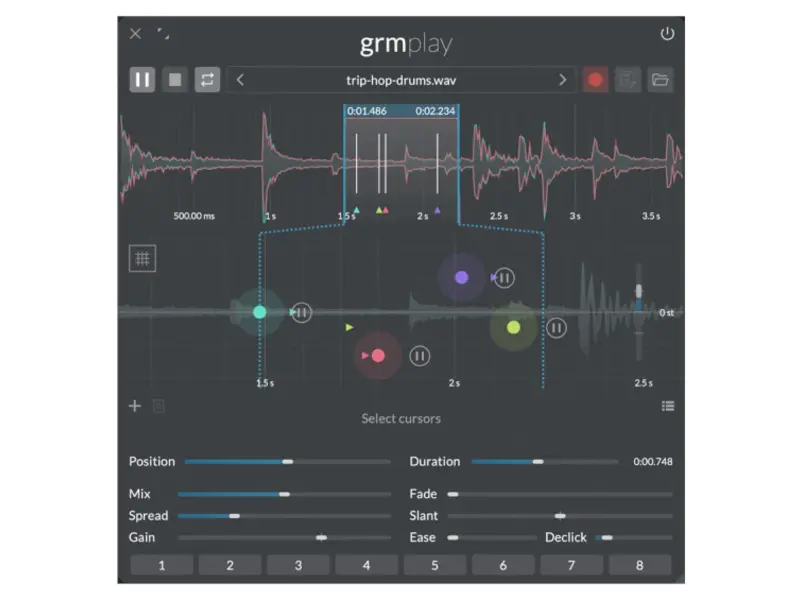
Who Is This For?
Atelier is not a general-purpose synth. It won't help you quickly dial in a warm pad or a punchy bass. But if you're interested in electroacoustic composition, sound design for film or installation work, or just exploring what sound can do when you treat it as material rather than melody - this is a tool worth spending time with.
The lineage here matters. GRM Tools didn't build this to compete with Serum or Vital. They built it to continue a 70-year conversation about the nature of sound and how we can work with it directly. That's a specific thing, and Atelier delivers it with clarity and care.
More News

Notes