Haken Audio ContinuuMini: Touch the Sound
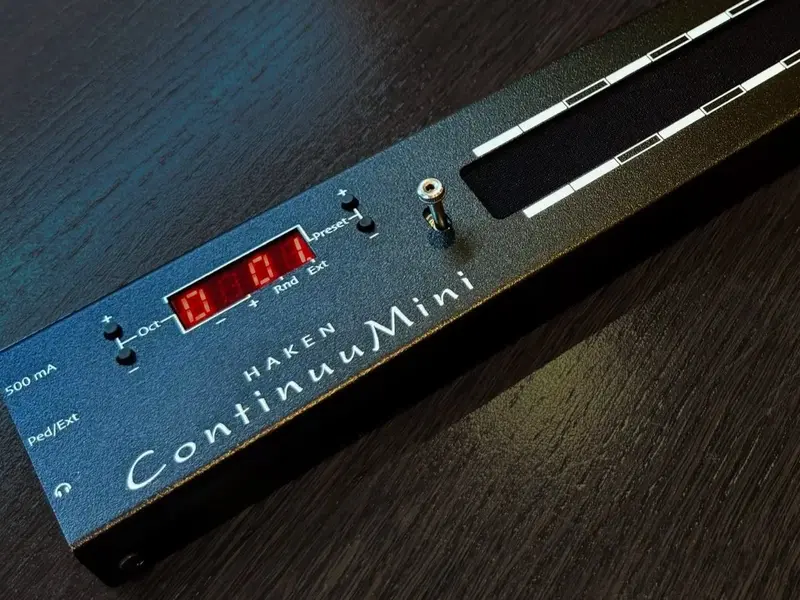
There are instruments that make you feel like you're missing something, and the ContinuuMini is one of them. This slim aluminium bar from Haken Audio - barely 530mm long and weighing just 250 grams - doesn't look like much at first glance. But once you understand what's happening under that red neoprene surface, it's difficult to think about it the same way as any other synthesizer.
The Surface Is the Instrument
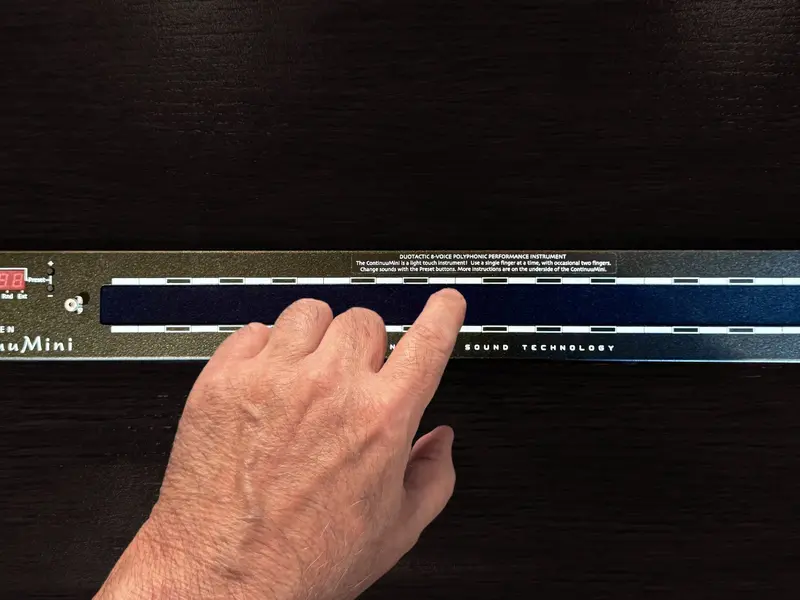
The ContinuuMini is built around a playing surface that tracks your fingers across three dimensions simultaneously. Moving left or right controls pitch - with a resolution down to one-tenth of a cent, which is far more precise than any conventional keyboard. Rocking your finger towards or away from you shifts timbre. Pressing deeper changes the amplitude. All of this happens at sub-millisecond speeds, and the instrument responds to a touch so light it reportedly feels gentler than pressing a piano key.
Under the red nylon and neoprene, the surface uses a hybrid system of Hall-effect sensors and a custom ribbon, with neodymium magnets and piano wire springs supporting a movable aluminium plate. It's a genuinely unusual piece of engineering for this size and price range.
The EaganMatrix Inside
The sound engine built into the ContinuuMini is the EaganMatrix, created by composer Edmund Eagan and DSP engineer Lippold Haken (a professor at the University of Illinois who originally developed the Continuum Fingerboard). It's a modular synthesis environment that combines subtractive synthesis, FM, physical modelling, waveguide synthesis, modal filter banks, and more - all in one package. There are over 500 factory presets ranging from acoustic instrument simulations to evolving electronic textures.
What makes the EaganMatrix interesting is how closely the synthesis algorithms are connected to performer gestures. The engine processes the continuous stream of finger data from the surface to shape sounds in ways that feel organic rather than mechanical - strings that breathe with your pressure, brass tones that brighten when you push forward, textures that shift as your finger drifts across the surface.
A Controller as Well
The ContinuuMini sends full MPE and MPE+ data over USB, so it can also drive external software or hardware synthesisers. When connected to a computer, the Haken Editor lets you build and edit custom patches inside the EaganMatrix. On its own, it runs from USB power alone and outputs audio through a 3.5mm stereo jack - no other gear required.
A Step Towards the Continuum
The full Continuum Fingerboard - Haken Audio's flagship instrument - covers up to seven octaves and supports full polyphonic multi-touch tracking. The ContinuuMini covers two octaves, tracks up to two fingers, and uses a slightly different surface technology. It's a meaningful compromise that brings the core experience to a much more accessible size and cost, though players coming from the full instrument will notice the differences.
Artists like Jordan Rudess and A.R. Rahman have used the Continuum series, and Edmund Eagan himself performed on it for Hans Zimmer's work on Dune: Part Two. The ContinuuMini is aimed at a broader audience - people who are curious about continuous pitch control and gesture-based synthesis but aren't ready (or don't need) to step up to the full instrument.
Whether you think of it as a compact controller, a standalone synth, or something harder to categorise, the ContinuuMini makes a strong case that the space between notes is worth exploring.
More News
Notes