Manifold Research Centre Antilope
The name says nothing and everything at the same time. Antilope, from Polish studio Manifold Research Centre, describes itself as a "pseudo drum machine" - built around a pair of pingable resonant filters, but calling it just a drum machine would be like calling a forest fire a campfire.
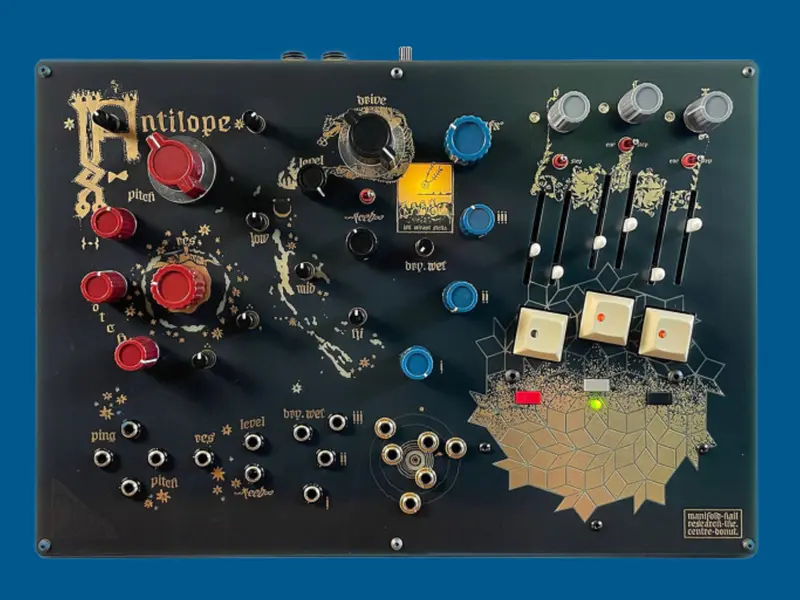
Manifold Research Centre has built a reputation for instruments that are loud, dirty, and thoroughly uninterested in playing it safe. The Antilope fits that reputation perfectly. Its sound engine starts with dual fully resonant filters that you ping with trigger signals to get percussive hits. Push the resonance up and those filters begin to self-oscillate, turning into a dual VCO that tracks V/Oct across roughly four octaves. So yes - it's a drum machine, until it becomes a synthesizer.
The Art of Pinging Filters
The core idea behind filter pinging is elegantly simple: send a short burst through a resonant filter and the filter rings back like a struck piece of metal. Depending on the filter's tuning and resonance, you get everything from a tight kick-like thud to something more like a tabla hit or a glass being flicked. Antilope gives you two of these filters with shared cutoff, resonance, and spread controls, so you are sculpting two voices that interact with each other.
The sounds that emerge - plucks, bongo slaps, metallic rings, and what MRC themselves describe as "ghastly squeals" - all run through an onboard distortion circuit modelled after the Sunn O))) Beta Bass amplifier. That is not an accidental choice of reference. The Sunn O))) Beta Bass was a gnarly, gritty beast, and borrowing its character means the Antilope can push sounds well into aggressive territory. There is also a multi-FX feedback path that adds another layer of chaos into the signal chain.
Three Channels, Endless Patterns
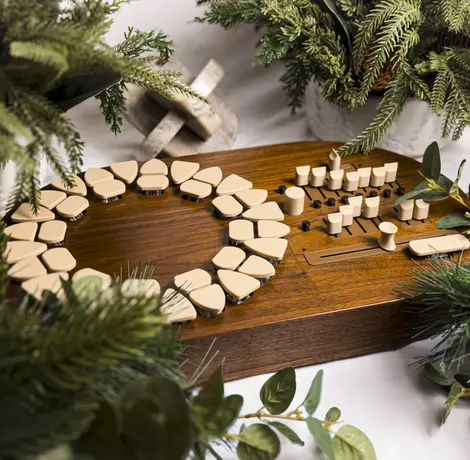
The pattern recorder is where things get genuinely interesting. You have three independent channels, each with its own CV and gate output on the front panel. Trigger events are recorded using Cherry MX switches - the kind used in mechanical keyboards - which gives them a very satisfying, physical feel.
Each channel can run in one of two modes. In AD envelope mode, the recorded pattern generates morphable attack-decay envelopes, with shapes ranging from exponential to logarithmic and speeds anywhere from 20ms to 8 seconds. In stepped voltage mode, the channel reads the fader positions as a sequence instead - a step sequencer built right into the rhythm recorder. Per-channel controls for phase, shape, and clock multiplication or division let you build polyrhythmic patterns from a single base recording, which is a wonderfully minimal approach to generating complex, shifting rhythms.
An Instrument That Does Not Behave
Someone described the Antilope as "a DFAM from hell," and while that might sound like a warning, it reads more like an invitation for a certain kind of musician. The DFAM is already on the wilder side of the spectrum; imagining something even further down that path gives you a clear sense of where this instrument lives.
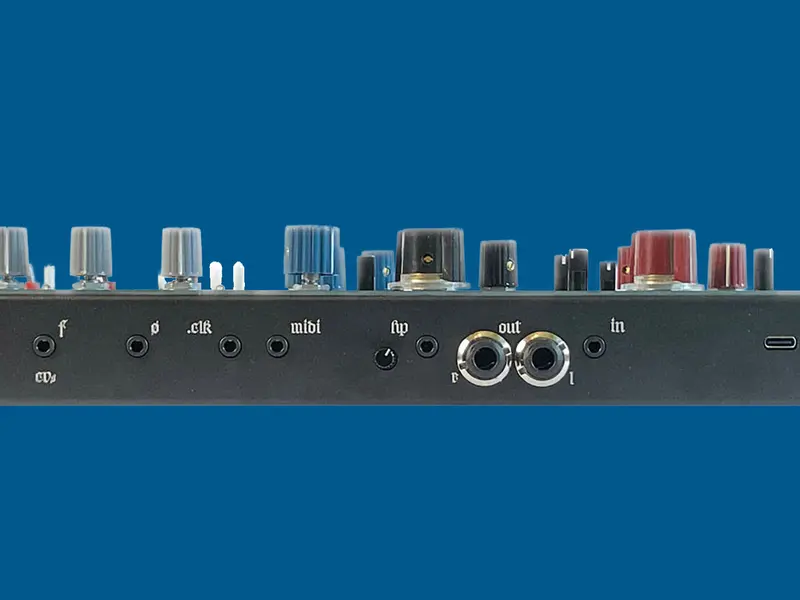
That said, the Antilope is not purely about destruction. It has a stereo line input for processing external sources through its filters and distortion, stereo 6.3mm outputs, and a headphone jack. It runs on USB-C power, making it genuinely portable. It plays well with Eurorack - voltage levels are compatible throughout - and there are MIDI clock, reset, and sync inputs for keeping it locked to the rest of your setup.
What I find compelling about it is the specific combination of constraints and freedom it offers. The pattern recorder keeps things grounded in rhythm while the filters and distortion pull everything toward the edge. You are always negotiating between structure and noise, and that tension is exactly where interesting music tends to happen. The Antilope was first shown at Superbooth 2025, and if it sounds anything like what the demos suggest, it deserves to find its way into the hands of every noise-inclined drummer and rhythm-obsessed experimenter out there.
More News
Notes