The Little Box That Does Three Things
There's something appealing about a device that doesn't ask you to choose. The Tangible Instruments Arpeggio is an arpeggiator. It's also a sequencer. And a synthesizer. All in a palm-sized box with a built-in speaker, running on a battery. It's the kind of thing you pick up and immediately start playing with.
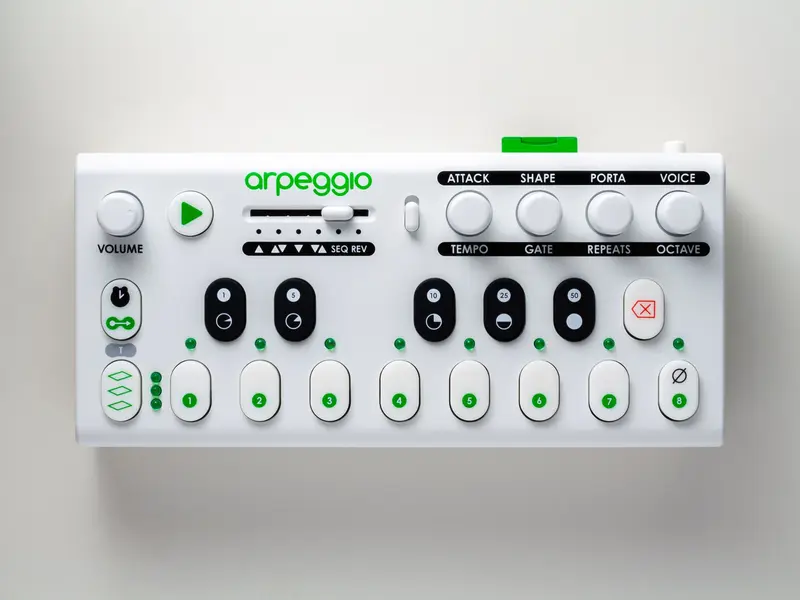
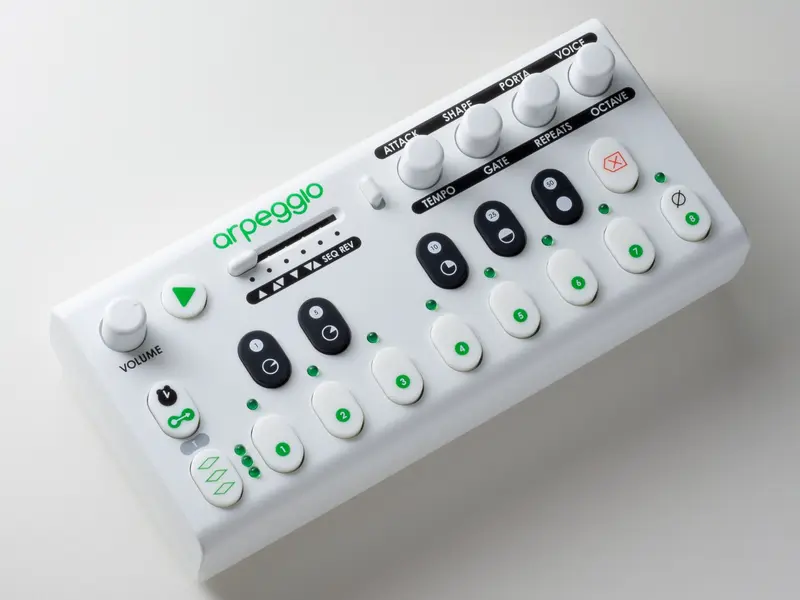
What makes the Arpeggio genuinely interesting is how it handles those three roles. Rather than burying everything in a single confusing interface, it ships with three physical overlays - one for each mode. You lay the overlay on the 17 soft-touch keypad buttons and suddenly the labels change, the context shifts, and the device becomes a different instrument. It's a simple idea, but it makes the workflow feel much more focused than you'd expect for something this compact.
Arpeggiation With Depth
The arpeggiator is where the name comes from, and it's the most developed part of the experience. You get five base note orders - Up, Down, Sequence, Reverse, and Random - and you can mix any two of them together. On top of that, there are modifiers like Inside Out, Skip Forward, Alternating First, and Zig Zag. The combinations multiply quickly, and it's surprisingly easy to stumble into something that sounds genuinely musical rather than mechanical.
This is the part that separates Arpeggio from a basic arpeggiator. Most hardware arps give you a handful of patterns and call it done. Here, the architecture is more like a toolkit - you're building the pattern yourself from components.
Sequencing and Saving
The sequencer mode lets you build monophonic sequences up to 128 notes long. You can adjust note lengths, add swing, apply slides between notes, and use probability controls to keep things from sounding too rigid. There's also per-note automation for gate, shape, and velocity - so sequences can breathe a bit rather than playing back robotically.
Storage is handled by an SD card, and the device can hold up to 512 sequences organised into a three-tier structure of sets, songs, and sequences. That's more than you'll ever need, but it's good to know it's there.
The Synth Inside
The built-in synthesizer is a two-oscillator virtual analogue monosynth. It's not the deepest instrument ever made, but with dual ADSR envelopes, dual LFOs, six oscillator waveforms, a low-pass filter, and 24 presets, it's more than enough for standalone noodling. When you're using the Arpeggio to control external gear, the internal synth takes a back seat - but it means you're never stuck without something to listen to.
Connectivity
Here's where Arpeggio earns its keep as a studio tool rather than just a toy. It has MIDI over DIN, USB, and Bluetooth LE, plus a control voltage output (0-5V, 1V/Oct), a gate output, and an analogue sync output running at 24 ppq. There's a quarter-inch audio out and a headphone jack, and the whole thing runs on either USB power or an 18650 lithium-ion battery.
The fact that it can act as a bridge between devices - translating and routing MIDI across different connection types - is a practical bonus that doesn't get mentioned enough. It's the kind of utility that becomes genuinely useful once you're knee-deep in a cable-heavy setup.
A Long Road to Release
Worth noting: the Arpeggio started life as a Kickstarter campaign back in 2015 and took nearly a decade to reach shipping. That's an unusual journey, and it invites some scepticism. But the device that eventually arrived looks polished and complete - not a rushed product trying to fulfil old promises. Whether the wait was worth it depends on how much you've been thinking about arpeggiators for the past ten years.
What Tangible Instruments has made is a device with a clear sense of purpose. It doesn't try to be everything - it tries to be three things, and it gives each of those things a proper interface and real thought. For someone who wants melody-generating tools in a small, portable, battery-powered form, it's a compelling option.
More News
Notes