Tilde Instruments Röntgen - Where X-Rays Meet Sound Waves
Let's step inside the laboratory of weird sounds, where German-engineered precision meets the unpredictable chaos of analog synthesis. The Tilde Instruments Röntgen - named after Wilhelm Röntgen, the discoverer of X-rays - promises to reveal hidden sonic dimensions you didn't know existed.

The X-Ray Vision of Sound
There's something poetic about naming a synthesizer after X-rays. Just as Röntgen's discovery allowed us to see through solid matter, this instrument lets you peer into the molecular structure of sound itself. Tilde Instruments describes it as "an analog instrument for improvisation and sonic exploration," but that's underselling it a bit. This is a tool for people who enjoy getting lost in their own sonic experiments.
What Makes It Tick
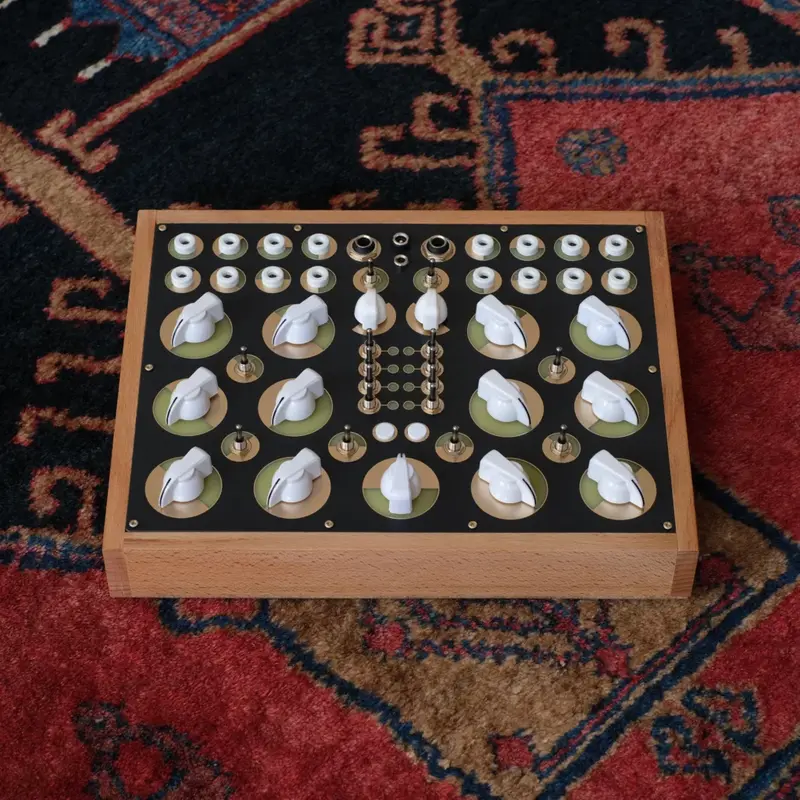
The Röntgen consists of three main sections that work together like a well-oiled experimental machine:
Dual Oscillators with Wave Shapers
Two independent oscillators sit at the heart of the Röntgen, each with its own pitch control and wave folder. Notice I said wave folder, not filter - this is firmly West Coast synthesis territory. Each oscillator has controls for pitch, wavefolder amount, and volume, with switches for FM modulation source selection. You can choose between square wave, external input, or triangle wave modulation, giving you a solid foundation for both harmonic and inharmonic tones.
The crossfader between the two oscillators lets you blend them seamlessly, creating everything from subtle beating effects to full-on sonic collisions.
Shift-Register Sequencers
Here's where things get interesting. The Röntgen features two random shift-register sequencers with independent clocks. These aren't your typical step sequencers - they generate evolving, semi-random patterns that can run endlessly or be constrained to 6, 7, or 8 steps using a rotary switch.
Each sequencer outputs both note sequences and two clocked random voltage sequences, which you can use as modulators for other parameters. The manual button lets you advance the sequence by hand, and in external clock mode, it functions as a hold button. The sequencers can be controlled by the opposite oscillator or via external clock inputs through banana jacks.
The VCA switches determine envelope behavior: short decay, off/mute, or continuous drone. In the upper position, the signal decay depends on the sequencer switch position (15), adding another layer of control over your sound's evolution.
Delay Section
The stereo delay is more than just an afterthought. It has controls for dry/wet mix, time, time modulation, and feedback. The modulation sources for each delay channel can be independently set to square wave from the oscillators, turned off, or fed with clocked random voltages from the sequencers.
An insert point between the oscillators and delay lets you patch in external effects, a volume pedal, or both, making the Röntgen play nicely with your existing setup.
Patching Without Patches
One of the most thoughtful design decisions is that the Röntgen can be played without patching a single cable. All the core functions are immediately accessible through the front panel controls. But when you're ready to dive deeper, the banana jack patch points open up a world of possibilities.
The banana jacks operate at ±5V, protected against overload with diodes. Inputs for FM modulation, delay modulation, and wavefolders are always active, while modulation inputs for both oscillators and the delay can be switched between internal sources and external connections.
External clock inputs for both sequencers let you sync with other gear or drive the sequences from your modular system. The layout is center-oriented, meaning left side pots turn right and right side pots turn left - something to keep in mind when you're in the flow.
Technical Bits
The Röntgen measures 280 × 220 × 60 mm and weighs 1.2 kg. It has a stereo input and output (6.3mm jacks at line level), plus a 12V DC center-positive input. No MIDI, no USB - just pure analog connectivity. The package includes an international power supply.
The Bottom Line
What makes the Röntgen special isn't any single feature - it's how everything comes together. The shift-register sequencers generate patterns that feel alive, constantly evolving but never completely random. The wave shapers add harmonics that breathe and move. The delay creates space and texture that becomes part of the instrument rather than just an effect.
This isn't a synthesizer for someone looking to dial in classic sounds or recreate vintage patches. It's for explorers who enjoy the journey more than the destination, who see happy accidents as creative opportunities, and who appreciate an instrument that rewards curiosity.
Tilde Instruments makes the Röntgen to order at €575 (excluding VAT), and honestly, that feels reasonable for a hand-crafted experimental instrument that encourages you to think differently about synthesis. Sometimes the best sounds come from pointing an X-ray at your musical assumptions and seeing what's really underneath.
More News
Notes