Phonic Bloom Siluria - Drone Synthesizer with FM Radio
More beautiful things to see on your table - this time from Phonic Bloom, a maker that's been quietly crafting unique instruments with a philosophy of turning everyday signals into music. Siluria is their take on the drone synthesizer, but it's not just another box that hums. This one listens to the world around you through FM radio and transforms those waves into something you can shape and play.
Touch and Sound
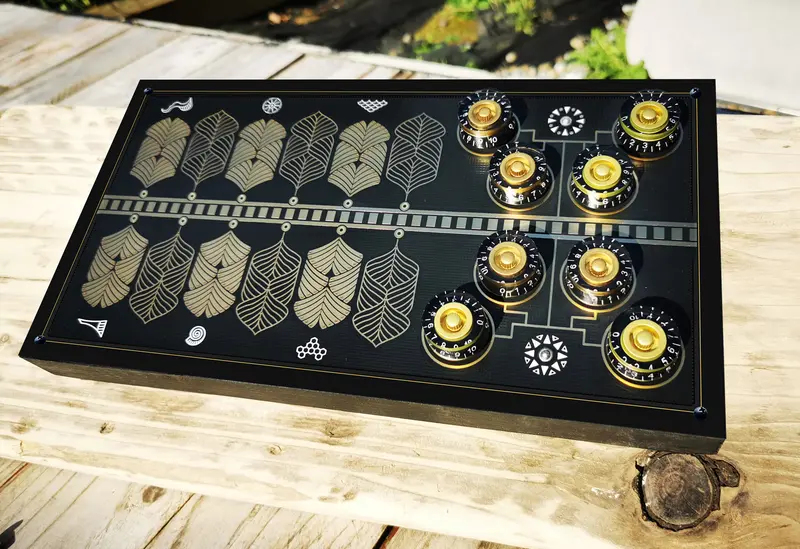
The interface is minimal but thoughtful. Twelve capacitive touch plates form the keyboard, each responding to velocity and polyphonic aftertouch. When you touch them, warm white LEDs light up, giving you that satisfying feedback that your gestures are being registered. Eight analog potentiometers sit ready for shaping the sound, smooth and precise under your fingers.
What makes this interesting is how the radio works here. It's not just a gimmick - the FM tuner acts as a modulation source, feeding unpredictable radio signals into your patches. You can also use line-in or load WAV files from an SD card, but there's something special about pulling sounds from the airwaves. The latest firmware update (1.1) adds tape-style playback for those WAV files, letting you loop, change speed (-4x to +4x), and reverse direction like you're manipulating actual tape.
What's Inside
Under the hood, there's a dual-core RISC-V processor running at 1GHz with 512MB of memory. The audio codec runs at 48kHz, giving you proper Hi-Fi quality. The synth engine is polyphonic and multi-timbral, with dual waveforms - one for the drone layer and another for the main voice. Scales are pre-defined and can be quantized or played with precise pitch control.
Effects are built in: filter with cutoff and resonance, reverb, flanger with level and detune, delay with adjustable parameters, and pitch shifting down one octave. These can process external signals too, which means you can run your FM radio or line-in through the effects chain and manipulate it in real time.
Practical Design
The physical design is elegant - a solid wood frame with black capacitive touch surface and gold-plated accents. Six 3.5mm jacks handle all connections: audio in/out, MIDI in/out, a separate FM radio output (giving you the unprocessed signal), and an external antenna connector. There's a small OLED display for navigation and a half-wavelength antenna built in.
MIDI works both ways - Siluria can control other gear and be controlled by it. Recording happens directly to the SD card, and files split automatically when you restart recording. USB-C provides power and data transfer, so you can access your recordings without removing the SD card.
What It's Not
There's no built-in speaker and no battery. You'll need headphones or an amplifier to hear it, and it needs USB power to run. These aren't flaws - they're design decisions that keep the device focused on what it does best: generating and processing sound.
Who It's For
If you're drawn to drones, ambient textures, or experimental sound design, Siluria offers a unique palette. The FM radio integration makes it unpredictable in good ways - you never quite know what signals you'll catch, and that randomness can spark ideas. It's compact enough to fit in any setup but capable enough to be the center of one.
More News
Notes