Yamaha DX200: The Groovebox That Brought FM Back
Let's look back into history a bit. Because a lot of cool stuff can still be found on eBay and Reverb. The Yamaha DX200 is one of those gems that deserves more attention - a compact groovebox that marked FM synthesis's return to the hardware world after nearly a decade of absence.
FM Synthesis Returns
When the DX200 appeared in 2001, it was something special: the first standalone FM synthesizer in almost 10 years. Yamaha built the DX200 around the same 6-operator FM synthesis engine that made the DX7 legendary, but with a crucial difference - 16 rubber pads and 16 real-time control knobs that made FM synthesis finally approachable.
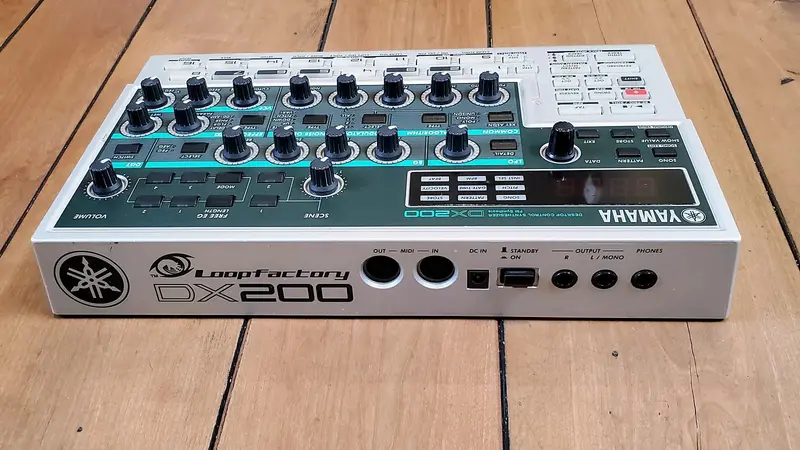
The DX200 features 16 voices of polyphonic FM synthesis with 32 algorithms, plus 32 additional voices of AWM2 sample playback for drums and percussion. What makes it stand out is the hands-on interface that was missing from 1980s FM synths. Those knobs provide direct access to FM parameters, LFO, envelope, filter, and effects - no menu diving required.
Beyond Classic FM
Yamaha added some clever features that expanded beyond traditional FM synthesis. The DX200 includes an advanced resonant multi-mode filter with variable slopes (12, 18, or 24 dB/oct) and multiple modes: lowpass, highpass, bandpass, and band reject. This filter lets you shape FM sounds as if they were analog, adding warmth and character.
The unit maintains full compatibility with DX7 System Exclusive MIDI data, so you can exchange patches with the classic synth. A bundled software editor for Mac and PC provides a graphic DX7 simulation interface for deeper programming.
The 16-Step Sequencer
The "Loop Factory" concept centers on the built-in 16-step sequencer. You get four tracks per pattern: one for FM sounds and three for drum tracks. Each of the 16 steps can have its pitch, gate time, and velocity independently tweaked in real time.
The DX200 includes 256 preset patterns and 128 user patterns, which can be chained together into 10 songs. Motion Control through the Free EG (envelope generator) lets you record parameter changes across 4 tracks, adding movement and variation to your patterns.
Scene Memory stores two complete parameter sets per pattern, allowing you to morph between different sound configurations on the fly. Pattern Assign mode lets you trigger different patterns from the keyboard buttons, perfect for live performance and improvisation.
Watch It in Action
Why It Matters
The DX200 was ahead of its time. In 2001, combining FM synthesis with a hands-on sequencer in a compact groovebox format seemed like a niche idea. But looking back, the DX200 predicted what would become popular nearly two decades later.
The Elektron Digitone, released in 2016, follows a similar philosophy - FM synthesis with a step sequencer and real-time parameter control. The difference is that Elektron had better timing and execution. The Digitone arrived when hardware grooveboxes were having a renaissance, and it refined the concept with modern sequencing features, parameter locks, and deeper sound design capabilities.
Korg's Opsix and Volca FM also show that the FM groovebox concept has legs. These devices prove the DX200's core idea was sound: make FM synthesis tactile and integrate it with sequencing for immediate music creation.
The DX200 bridged two eras. It took the FM sound that defined the 1980s and repackaged it for electronic music production with loops and patterns. While it didn't set the world on fire in 2001, it established a template that later devices would refine and popularize.
Finding One Today
The DX200 shows up regularly on the used market. It's a compact unit that offers genuine FM synthesis with a practical workflow. If you're into vintage gear or want to explore classic FM sounds with modern convenience, the DX200 is worth checking out.
Just remember: this is a groovebox from the early 2000s, so expect the limitations of that era. But for creating FM-based loops and experimenting with algorithmic synthesis, it still holds up surprisingly well.
More News
Notes